
Privileged Access Management Checklist for Secure Systems
Privileged access management prevents lateral movement by enforcing strict boundaries around administrative credentials and service accounts.
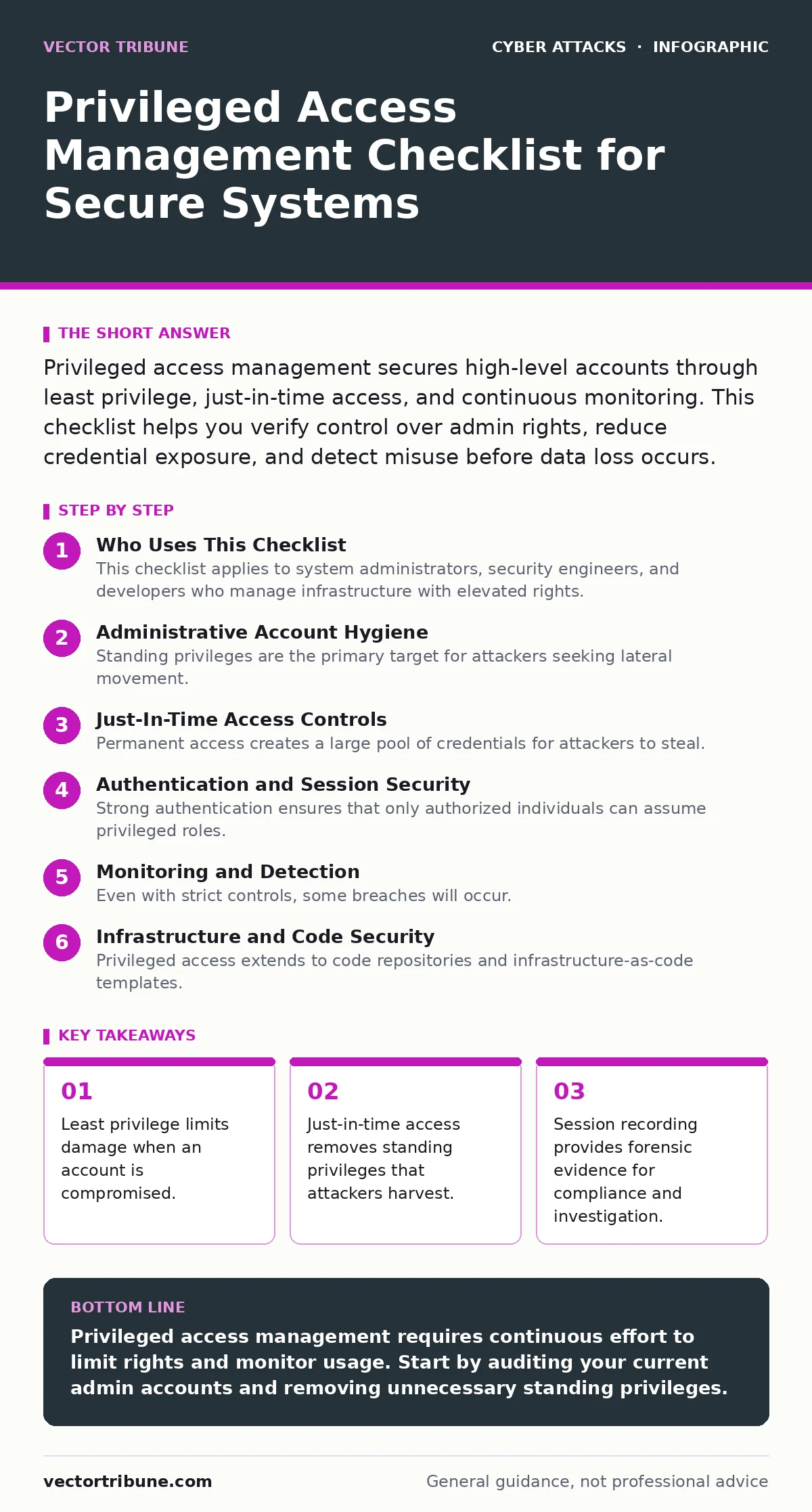
Privileged access management secures high-level accounts through least privilege, just-in-time access, and continuous monitoring. This checklist helps you verify control over admin rights, reduce credential exposure, and detect misuse before data loss occurs.
Who Uses This Checklist
This checklist applies to system administrators, security engineers, and developers who manage infrastructure with elevated rights. Use it to audit your current controls against established security frameworks. Review each item quarterly or after any significant infrastructure change. The goal is to reduce the attack surface for accounts that can modify system configurations or access sensitive data. Privileged access management is not a product but a set of practices that limit who can do what, when, and where.
Administrative Account Hygiene
Standing privileges are the primary target for attackers seeking lateral movement. Removing unnecessary rights reduces the impact of a breach.
- Remove local administrator rights from standard users: Standard users cannot install malware that affects the entire system.
- Disable unused administrator accounts: Dormant accounts are invisible entry points that bypass multi-factor authentication prompts.
- Enforce unique passwords for admin accounts: Credential stuffing attacks fail when admin passwords differ from user passwords.
- Rotate credentials for service accounts: Shared static passwords persist in code repositories and configuration files indefinitely.
- Disable built-in administrator accounts: Attackers often target default accounts like Administrator or root because their SIDs are predictable.
Just-In-Time Access Controls
Permanent access creates a large pool of credentials for attackers to steal. Just-in-time access grants rights only when needed and revokes them immediately after.
- Implement time-bound access grants: Temporary access limits the window for attackers to exploit stolen credentials.
- Require approval workflows for elevation: Human review catches anomalous requests that automated systems might miss.
- Use role-based access control: Roles define permissions by function rather than by individual, simplifying audits.
- Automate privilege revocation: Manual revocation is error-prone and leaves orphaned privileges that accumulate over time.
- Separate development and production credentials: Developers should not have production write access to prevent accidental or malicious changes.
Authentication and Session Security
Strong authentication ensures that only authorized individuals can assume privileged roles. Multi-factor authentication adds a layer that passwords alone cannot provide.
- Enforce multi-factor authentication for all admin access: MFA prevents attackers from using stolen passwords to gain entry.
- Use hardware security keys for root access: Hardware keys are resistant to phishing and SIM swapping attacks.
- Limit session duration for elevated tasks: Short sessions reduce the risk of session hijacking if a device is left unattended.
- Record privileged sessions: Session recording allows you to replay actions for forensic analysis and compliance.
- Block clipboard and file transfers in remote sessions: These channels allow attackers to exfiltrate data from the target system.
Monitoring and Detection
Even with strict controls, some breaches will occur. Monitoring detects anomalous behavior that indicates a compromised privileged account.
- Alert on off-hours administrative access: Admins rarely work at unusual times, making these events high-risk indicators.
- Monitor for privilege escalation attempts: Failed attempts to gain higher rights often precede a successful breach.
- Log all changes to security policies: Configuration changes can disable security controls or create backdoors.
- Correlate alerts with user behavior analytics: Context from normal user behavior helps distinguish legitimate actions from attacks.
- Review access logs weekly: Regular review ensures that anomalies are not missed by automated alerting systems.
See also: What Is Typosquatting in the Context of DNS Attacks · Watering Hole Attacks in Cyber Security: How Compromise Happens
Infrastructure and Code Security
Privileged access extends to code repositories and infrastructure-as-code templates. Compromising these allows attackers to deploy malicious software at scale.
- Scan code repositories for secrets: Hardcoded credentials in code are visible to anyone with repository access.
- Sign infrastructure-as-code templates: Signing ensures that only authorized changes are deployed to production environments.
- Restrict write access to deployment pipelines: Compromised pipelines can inject malicious code into trusted software updates.
- Use ephemeral build environments: Temporary environments prevent attackers from persisting between builds.
- Audit API key permissions: Overly permissive API keys allow attackers to access cloud resources directly.
Integration with Related Threat Models
Privileged access management intersects with other security domains. Understanding these connections helps you build a more resilient defense. For example, protecting against phishing reduces the likelihood of credential theft. Similarly, mitigating vendor email compromise prevents attackers from tricking staff into granting access. You should also consider how API abuse can bypass traditional access controls if endpoints are not properly secured. While shoulder surfing is a physical threat, it highlights the need for screen privacy in sensitive areas. Finally, watering hole attacks often target privileged users who visit industry-specific sites, making endpoint protection critical.
Key takeaways
- Least privilege limits damage when an account is compromised.
- Just-in-time access removes standing privileges that attackers harvest.
- Session recording provides forensic evidence for compliance and investigation.
Privileged access management requires continuous effort to limit rights and monitor usage. Start by auditing your current admin accounts and removing unnecessary standing privileges.
Frequently asked questions
Does multi-factor authentication replace the need for privileged access management?
No, multi-factor authentication verifies identity but does not limit what an authenticated user can do. Privileged access management controls permissions and duration of access.
How often should privileged credentials be rotated?
Rotate credentials immediately after any suspected compromise and on a regular schedule, such as every 90 days. Automated rotation tools reduce the administrative burden.
Can just-in-time access impact productivity?
It may add a small delay for elevation requests, but it significantly reduces risk. Automation and approval workflows can minimize the disruption to legitimate tasks.
What is the difference between privileged access management and identity and access management?
Identity and access management handles all user identities, while privileged access management focuses specifically on high-privilege accounts that can alter system configurations.
How this guide was produced: written by the Vector Tribune editorial team with AI assistance, checked against the public references listed below, and reviewed when the facts change. See our editorial policy or report an error.