
Cloud Controls Matrix: Small Business Security Checklist
The Cloud Controls Matrix maps abstract security standards to specific cloud actions, revealing gaps that generic checklists miss during infrastructure audits.
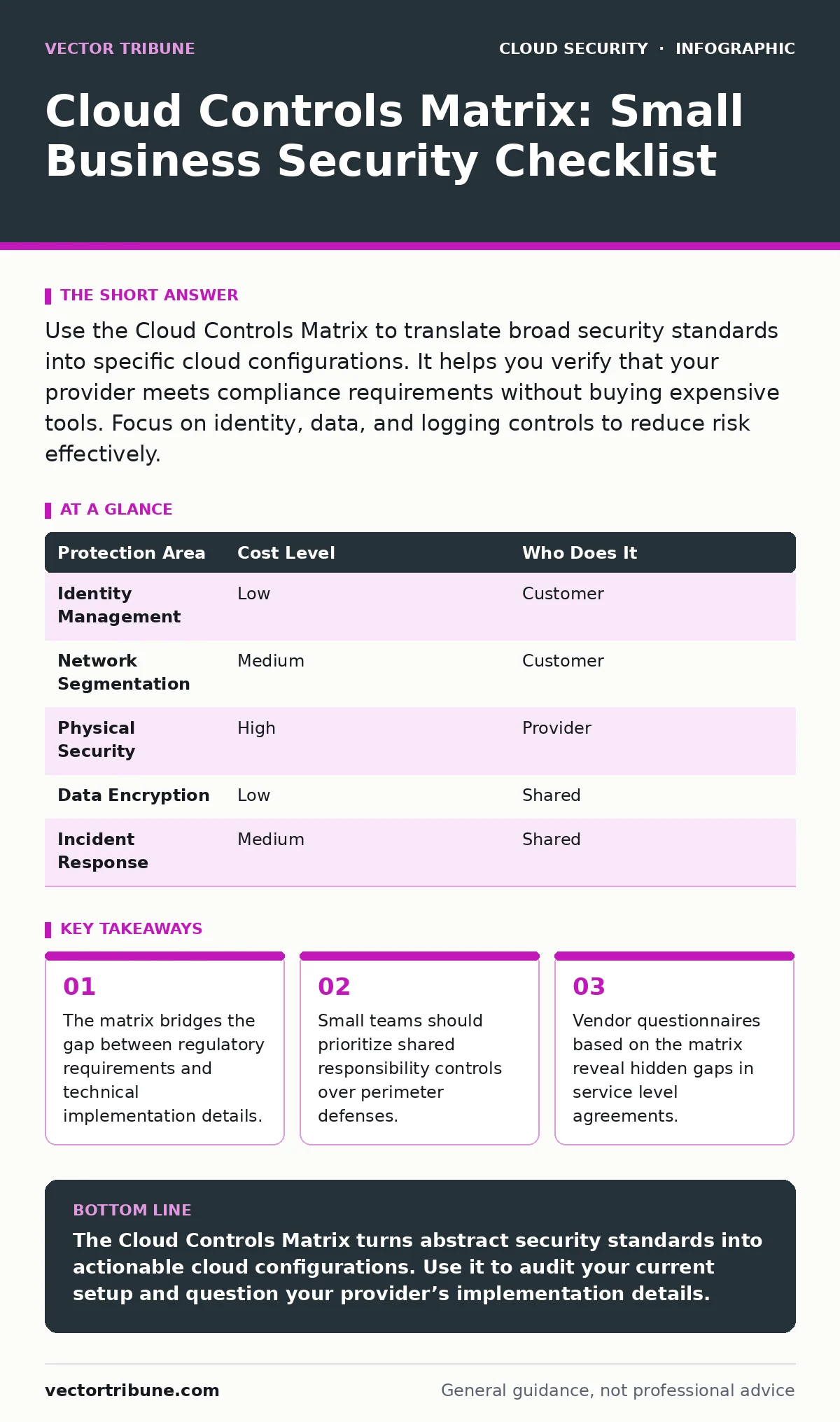
Use the Cloud Controls Matrix to translate broad security standards into specific cloud configurations. It helps you verify that your provider meets compliance requirements without buying expensive tools. Focus on identity, data, and logging controls to reduce risk effectively.
Why the Matrix Matters for Small Teams
The Cloud Controls Matrix (CCM) translates high-level security frameworks into specific cloud actions. It maps controls from standards like ISO 27001 or NIST to cloud-native implementations. Small organizations often lack dedicated security staff. They rely on default settings that rarely align with strict compliance needs. The matrix exposes these misalignments before an audit occurs.
You might think buying a premium cloud plan covers all security bases. It does not. The matrix separates provider responsibilities from customer responsibilities. This distinction prevents false confidence in security posture. It forces you to define exactly who manages encryption keys, logging retention, and identity verification.
Cloud misconfigurations remain the primary cause of data exposure. The matrix provides a structured way to identify these errors. It turns vague advice into actionable checks. You can verify each control against your actual infrastructure. This reduces reliance on trust and increases verification.
Mapping Controls to Practical Actions
Start by selecting the controls relevant to your industry. Do not attempt to implement every control in the matrix. Focus on identity and access management first. These controls prevent unauthorized users from reaching sensitive data. Next, address data protection controls. Ensure encryption is active at rest and in transit.
Logging and monitoring controls provide visibility into system activity. Without logs, you cannot detect breaches or investigate incidents. The matrix specifies what logs to collect and how long to retain them. Implementing these controls early saves time during incident response. It also satisfies basic regulatory requirements for most sectors.
Consider the cost of each control. Some controls require third-party tools. Others are native to the cloud platform. The matrix helps you prioritize controls that offer the highest security return for the lowest cost. You can defer complex controls until your team gains more experience.
| Protection Area | Cost Level | Who Does It |
|---|---|---|
| Identity Management | Low | Customer |
| Network Segmentation | Medium | Customer |
| Physical Security | High | Provider |
| Data Encryption | Low | Shared |
| Incident Response | Medium | Shared |
The Shared Responsibility Trap
Cloud providers secure the infrastructure. You secure what you put on it. The matrix clarifies this boundary. Many small businesses assume the provider handles software patching. This assumption fails when you run custom applications or containers. You must patch the operating system and application code yourself.
Container escape vulnerabilities illustrate this risk. If you do not manage container images correctly, attackers can break out into the host. The matrix highlights this control gap. It forces you to evaluate image signing and runtime security. Ignoring these controls leaves your infrastructure exposed to lateral movement.
Shared responsibility also applies to backups. The provider ensures their storage systems do not fail. You must ensure your data is backed up and recoverable. Cloud backup strategies must be tested regularly. The matrix reminds you to verify restoration procedures, not just backup creation.
What to Ask Your IT Provider
Your IT provider or managed service partner must understand the matrix. They should not just implement controls but explain them. Ask specific questions to verify their competence. Do not accept vague answers about "best practices." Demand details on implementation and monitoring.
- How do you map our specific compliance needs to the Cloud Controls Matrix domains?
- Which controls in the matrix are automated versus manual in your setup?
- How do you handle privilege escalation requests for administrative accounts?
- What is your process for detecting and responding to cloud metadata service attacks?
- Do you provide regular reports showing control status against the matrix?
These questions reveal whether your provider uses a checklist approach or a risk-based approach. A good provider will explain why certain controls are prioritized over others. They will also explain the trade-offs involved in each decision.
Handling Insecure Cloud APIs
APIs are the interface between your applications and the cloud infrastructure. Insecure cloud APIs can expose sensitive data if not properly secured. The matrix includes controls for API security. These controls require authentication, authorization, and rate limiting.
You must verify that your applications validate input and output data. Unvalidated inputs can lead to injection attacks. The matrix highlights the need for API gateways and web application firewalls. These tools filter malicious traffic before it reaches your servers.
Rate limiting prevents abuse and denial-of-service attacks. Without it, attackers can exhaust your resources. The matrix ensures you implement these limits at the API level, not just the network level. This adds a layer of security that is difficult to bypass.
See also: Attack Surface Management Mistakes and How to Fix Them · Difference Between Logging and Monitoring: Cloud Security Architecture
Detecting Cloud Cryptojacking Early
Cryptojacking involves unauthorized use of your compute resources to mine cryptocurrency. It drains your budget and degrades performance. The matrix includes controls for resource monitoring and anomaly detection. These controls help you identify unusual CPU or GPU usage patterns.
You must monitor for processes that consume excessive resources. The matrix specifies the need for continuous monitoring tools. These tools alert you to deviations from baseline behavior. Early detection prevents significant financial loss and service disruption.
Regular audits of running processes and scheduled tasks are also necessary. The matrix encourages you to review these regularly. This manual check complements automated monitoring. It helps catch sophisticated attacks that evade automated detection.
Building a Resilient Foundation
The Cloud Controls Matrix is not a one-time exercise. It is a living document that evolves with your infrastructure. Update your controls as you add new services or features. Review the matrix quarterly to ensure continued compliance.
Cloud disaster recovery plans must align with your matrix controls. If your controls fail, your recovery plan must account for that failure. Test your recovery procedures regularly. The matrix helps you define Recovery Time Objectives and Recovery Point Objectives.
By using the matrix, you build a security foundation that scales. You avoid costly rework later. You also demonstrate due diligence to clients and regulators. This trust is valuable for small businesses competing with larger firms.
Key takeaways
- The matrix bridges the gap between regulatory requirements and technical implementation details.
- Small teams should prioritize shared responsibility controls over perimeter defenses.
- Vendor questionnaires based on the matrix reveal hidden gaps in service level agreements.
The Cloud Controls Matrix turns abstract security standards into actionable cloud configurations. Use it to audit your current setup and question your provider’s implementation details.
Frequently asked questions
Is the Cloud Controls Matrix free to use?
The framework itself is often available through industry groups, but specific compliance consulting or automated tools may cost money.
Can I use the matrix for on-premise servers?
The matrix is designed for cloud environments, but many controls apply to on-premise infrastructure with slight modifications.
How often should I review my matrix controls?
Review your controls quarterly or whenever you make significant changes to your cloud infrastructure or applications.
Does the matrix cover data privacy laws?
The matrix covers security controls that support privacy, but it does not replace legal advice on specific privacy regulations.
How this guide was produced: written by the Vector Tribune editorial team with AI assistance, checked against the public references listed below, and reviewed when the facts change. See our editorial policy or report an error.