
Patch Prioritization: Benefits, Limits, and When to Skip It
Prioritization reduces exposure by focusing on reachable flaws, but it cannot eliminate risk from unknown or internal zero-day attacks.
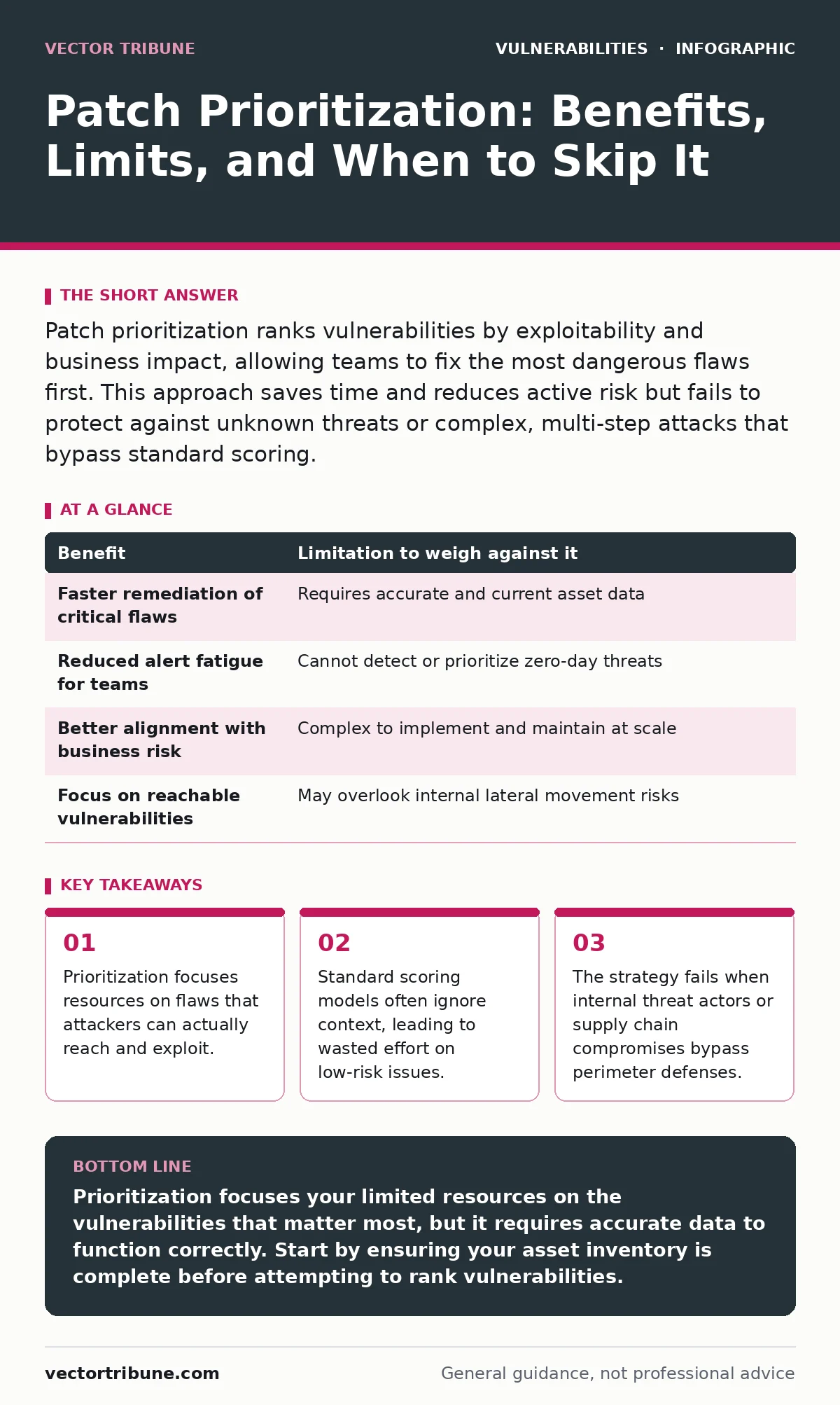
Patch prioritization ranks vulnerabilities by exploitability and business impact, allowing teams to fix the most dangerous flaws first. This approach saves time and reduces active risk but fails to protect against unknown threats or complex, multi-step attacks that bypass standard scoring.
How Prioritization Changes Security Operations
Patch prioritization shifts security work from a race against time to a calculated risk reduction effort. Traditional patching treats every advisory with equal urgency, which overwhelms teams and delays critical fixes. Prioritization introduces context to the process. You evaluate each vulnerability based on whether an attacker can reach the affected system, whether the flaw is easily exploitable, and what data resides on that system. This method acknowledges that not all security flaws pose the same immediate danger to your organization.
The mechanism relies on combining public vulnerability data with your specific environment details. You map software versions to network segments and user roles. This mapping reveals which flaws are exposed to the internet and which are hidden behind authentication layers. By filtering out unreachable vulnerabilities, you reduce the noise. You stop wasting cycles on fixing flaws in systems that no external attacker can touch. This focus allows your team to address the few high-impact issues that matter most.
Concrete Benefits of Focused Patching
The primary benefit of prioritization is reduced mean time to remediation for critical risks. When you have 500 open vulnerabilities, fixing the 5 that allow unauthenticated remote code execution on public-facing servers takes precedence. These flaws require no credentials and often have automated exploits available. Fixing them removes the easiest entry points for attackers. You protect your most valuable assets without attempting to close every possible door simultaneously. This targeted approach prevents burnout among security engineers who otherwise face an endless backlog.
Another benefit is the alignment of security efforts with business value. A flaw in a legacy internal tool used by three employees carries less risk than a flaw in the customer payment gateway. Prioritization forces you to consider the business impact of a breach. You allocate resources where the financial and reputational damage would be highest. This strategic alignment ensures that security spending directly supports organizational stability. It transforms security from a technical checkbox exercise into a business risk management function.
Honest Limitations of Risk-Based Patching
Prioritization does not eliminate risk; it manages it. The most significant limitation is the reliance on known information. You can only prioritize what you know exists. Zero-day vulnerabilities have no public score and no patch. An attacker exploiting a previously unknown flaw will bypass your prioritization model entirely. Your system remains vulnerable to novel attack vectors that do not appear in any database. This blind spot means that prioritization alone cannot guarantee security.
Another limitation is the complexity of implementation. Accurate prioritization requires detailed and up-to-date context about your infrastructure. If your IT asset inventory is incomplete or outdated, your prioritization decisions will be flawed. You might prioritize a system that is already decommissioned or miss a critical server that was recently added. Maintaining this context requires continuous effort and integration between security tools and configuration management databases. The overhead of keeping this data accurate can sometimes outweigh the benefits for smaller environments.
Weighing Benefits Against Limitations
Every benefit of prioritization comes with a corresponding limitation that you must manage. The table below outlines these trade-offs to help you assess whether the strategy fits your operational capacity.
| Benefit | Limitation to weigh against it |
|---|---|
| Faster remediation of critical flaws | Requires accurate and current asset data |
| Reduced alert fatigue for teams | Cannot detect or prioritize zero-day threats |
| Better alignment with business risk | Complex to implement and maintain at scale |
| Focus on reachable vulnerabilities | May overlook internal lateral movement risks |
When It Is Worth It
Prioritization is worth the investment when your organization manages a large and diverse technology stack. If you run hundreds of servers, containers, and applications, you cannot patch everything at once. The volume of updates exceeds your team's capacity. In this scenario, prioritization is necessary to prevent paralysis. It allows you to make rational choices about which systems to protect first. You accept residual risk in lower-priority areas to ensure high-priority areas are secure.
It is also worth it when you host sensitive data or provide critical services. If a breach would result in significant regulatory penalties or loss of customer trust, you need to minimize the attack surface aggressively. Prioritization helps you identify the paths an attacker would take to reach that data. You can then harden those specific paths. This is particularly relevant for systems that handle financial transactions or personal health information. The cost of a breach far exceeds the cost of maintaining a robust prioritization workflow.
See also: Web Application Firewall Tuning for Small Teams · Medical Device Vulnerabilities: 7 Mistakes That Leave Systems Open
When It Is Not Worth It
Prioritization is not worth the effort for very small environments with few assets. If you manage only a handful of servers and applications, you can patch them all quickly. The overhead of setting up a prioritization engine may exceed the time saved. In these cases, a simple schedule of regular updates is more efficient. You avoid the complexity of risk scoring and context mapping. Simplicity reduces the chance of configuration errors that could introduce new vulnerabilities.
It is also not worth it if your organization lacks basic visibility into its infrastructure. If you do not know what software is running on your systems, you cannot prioritize effectively. Attempting to prioritize without accurate data leads to false confidence. You might believe a system is secure because it was not prioritized, when in reality it is exposed. In this case, focus on building a complete IT asset inventory first. Prioritization is a secondary step that depends on foundational visibility.
Integrating With Broader Security Practices
Patch prioritization works best when combined with other security disciplines. It does not replace the need for secure coding practices or strong access controls. You should still write code that avoids common mistakes like buffer overflow vulnerabilities. Prioritization handles the vulnerabilities that slip through, but it does not prevent them from existing in the first place. A layered defense strategy ensures that if one layer fails, others remain in place.
You should also consider how prioritization interacts with your security advisory reading process. Not every advisory requires immediate action. Some describe theoretical flaws that are difficult to exploit in practice. By reading advisories carefully, you can determine if a vulnerability is relevant to your stack. This manual review complements automated prioritization tools. It adds a human element of judgment that algorithms might miss. This combination of automation and expert review creates a more resilient patching workflow.
The Hidden Cost of Context Management
The hidden cost of patch prioritization is the continuous effort required to maintain context. Your environment changes constantly. New servers are deployed, old ones are retired, and configurations are updated. If your prioritization model relies on static data, it becomes inaccurate quickly. You must integrate your security tools with your configuration management systems to keep data fresh. This integration requires technical expertise and ongoing maintenance.
Imagine you deploy a new microservice that exposes a port to the internet. If your prioritization tool does not detect this change, it will continue to treat the service as internal. You might delay patching a critical flaw because the tool thinks it is low risk. This gap between reality and your model creates a false sense of security. You must regularly validate your asset data against your network scans. This validation step is often overlooked but is critical for the effectiveness of prioritization.
Key takeaways
- Prioritization focuses resources on flaws that attackers can actually reach and exploit.
- Standard scoring models often ignore context, leading to wasted effort on low-risk issues.
- The strategy fails when internal threat actors or supply chain compromises bypass perimeter defenses.
Prioritization focuses your limited resources on the vulnerabilities that matter most, but it requires accurate data to function correctly. Start by ensuring your asset inventory is complete before attempting to rank vulnerabilities.
Frequently asked questions
How does patch prioritization handle supply chain risks?
It struggles with supply chain risks because it focuses on direct vulnerabilities in your systems. You must also monitor **dependency confusion attacks** and third-party component updates separately, as these bypass traditional patching workflows.
Can prioritization replace regular patching schedules?
No, prioritization supplements regular schedules by ordering the work. You still need a baseline schedule to address lower-priority vulnerabilities over time. Ignoring low-priority flaws allows them to accumulate and potentially combine into larger risks.
What is the role of severity scores in prioritization?
Severity scores provide a starting point but lack context. They do not account for your specific network topology or exposure. You must adjust scores based on reachability and business impact to make meaningful prioritization decisions.
How do I prioritize patches for internal systems?
Focus on systems that handle sensitive data or have high privileged access. Internal flaws are less urgent than external ones, but they can lead to **Linux kernel privilege escalation** if an attacker gains initial access.
How this guide was produced: written by the Vector Tribune editorial team with AI assistance, checked against the public references listed below, and reviewed when the facts change. See our editorial policy or report an error.