
EPSS Percentiles Explained: How to Prioritize Patching Without Panic
EPSS percentiles transform raw exploit probabilities into actionable ranking tiers, allowing teams to fix the most likely threats first rather than chasing every vulnerability.
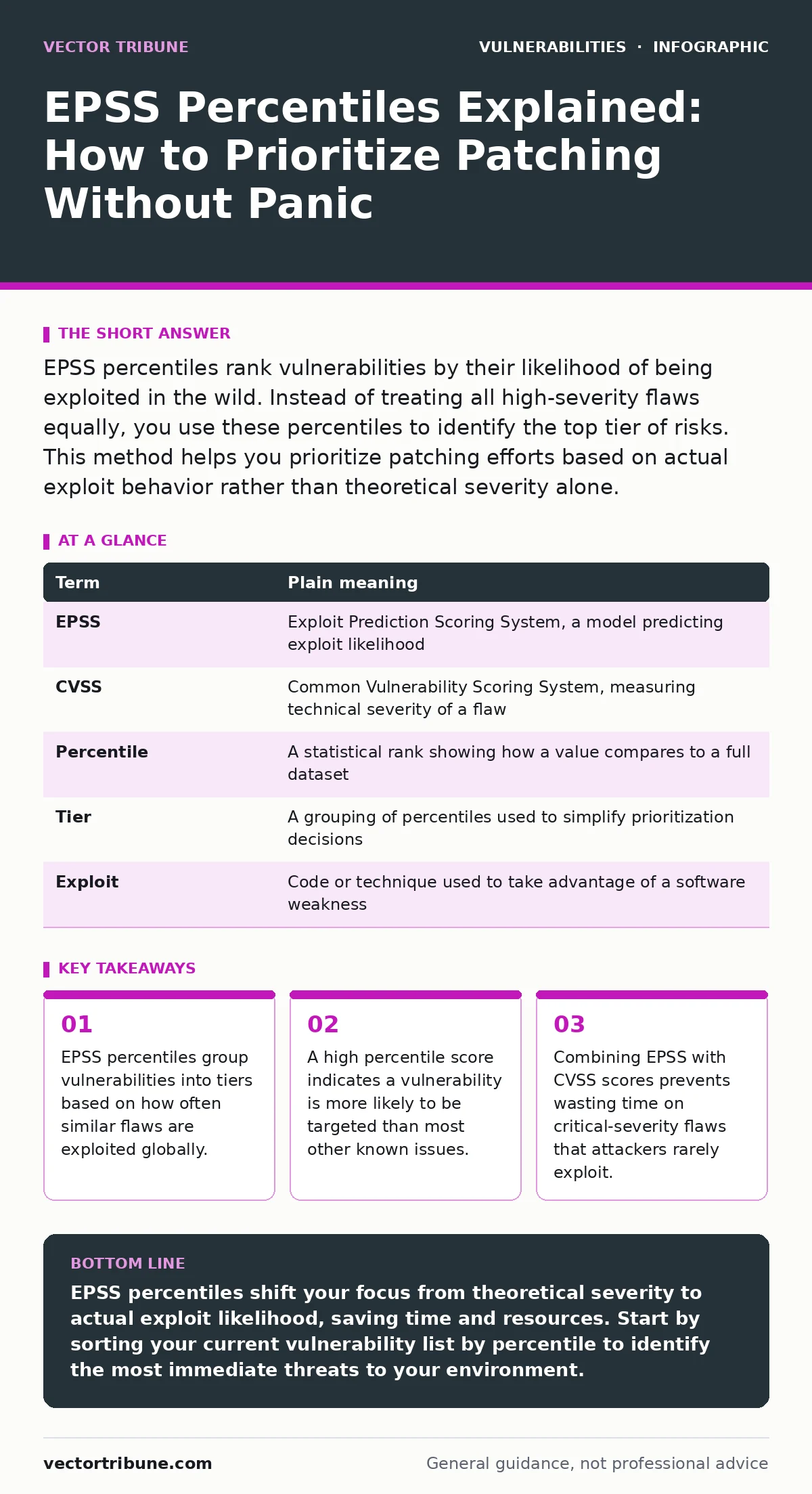
EPSS percentiles rank vulnerabilities by their likelihood of being exploited in the wild. Instead of treating all high-severity flaws equally, you use these percentiles to identify the top tier of risks. This method helps you prioritize patching efforts based on actual exploit behavior rather than theoretical severity alone.
The Airport Security Analogy
Imagine you are managing security at a busy international airport. Every passenger represents a software vulnerability. Some passengers have red flags on their tickets, indicating high theoretical risk. If you stop every passenger with a red flag, security lines stall and critical threats slip through unnoticed. You need a way to distinguish between a passenger who is merely suspicious and one who is actively planning an attack. EPSS percentiles act as your intelligence system. They tell you which passengers have been seen moving toward restricted areas in other airports. This allows you to focus your limited security staff on the individuals most likely to cause harm.
Core Terminology and Definitions
Understanding EPSS requires clarity on three distinct metrics. CVSS measures the technical severity of a flaw. EPSS predicts the likelihood of exploitation. Percentiles rank these predictions against all known vulnerabilities. This ranking removes the guesswork from triage. You no longer debate whether a flaw is "important." You look at its percentile tier. The data tells you if the flaw is being actively weaponized by threat actors globally. This shifts your focus from theoretical damage to observed behavior.
| Term | Plain meaning |
|---|---|
| EPSS | Exploit Prediction Scoring System, a model predicting exploit likelihood |
| CVSS | Common Vulnerability Scoring System, measuring technical severity of a flaw |
| Percentile | A statistical rank showing how a value compares to a full dataset |
| Tier | A grouping of percentiles used to simplify prioritization decisions |
| Exploit | Code or technique used to take advantage of a software weakness |
The Trap of Severity Scores
Many teams rely solely on CVSS scores to prioritize work. This approach fails because severity does not equal exploitability. A buffer overflow vulnerability might have a perfect CVSS score of 10.0, indicating catastrophic potential. However, if the flaw requires complex conditions or specific hardware, attackers may ignore it.
Meanwhile, a low-severity configuration error might be trivial to exploit and widely used. Treating all high-CVSS scores as equal creates alert fatigue. You waste resources patching flaws that no one attacks. You miss the low-severity flaws that are actually being exploited. This disconnect is why EPSS percentiles are necessary. They add the dimension of real-world usage to your risk assessment.
Interpreting the Percentile Tiers
EPSS percentiles are often grouped into tiers for easier decision-making. The top tier usually includes the most likely exploited vulnerabilities. These are the passengers at the airport trying to board without tickets. You must address these immediately. The middle tier contains vulnerabilities that are occasionally exploited. These require monitoring and conditional patching. The bottom tier includes flaws that are rarely or never seen in the wild. These can often be deferred. This tiered approach allows you to allocate resources efficiently. You fix the immediate threats first. You manage the medium risks over time. You archive the low risks. This structure prevents paralysis by analysis.
Integrating with Asset Inventory
Percentiles tell you what is likely to be exploited globally. They do not tell you if you are affected. You must cross-reference EPSS data with your IT asset inventory. If a vulnerability is in the 99th percentile but you do not run the affected software, the risk is zero. Conversely, a vulnerability in the 50th percentile might be critical if it affects your primary database server. Context matters. You cannot automate risk entirely. You must understand your own environment. It ensures you are not patching air. It also prevents you from missing internal risks that global data might underrepresent.
See also: Web Application Firewall Tuning for Small Teams · Patch Prioritization: Benefits, Limits, and When to Skip It
Common Points of Confusion
Readers often confuse EPSS with CVSS. They are not interchangeable. CVSS is static and technical. EPSS is dynamic and behavioral. Another confusion is assuming EPSS replaces all other security tools. It does not. It complements them. You still need to understand memory-safe programming languages to prevent future flaws. You still need to monitor for server-side request forgery (SSRF) in your web applications. EPSS simply helps you decide which known flaw to fix first. It is a prioritization engine, not a detection tool. It does not find vulnerabilities. It ranks them. Understanding this distinction prevents misuse.
Try This Now
Implementing EPSS percentiles does not require new software. It requires a change in process. Start by identifying your top ten highest-risk assets. Then check for known vulnerabilities against those assets. Finally, sort those vulnerabilities by their EPSS percentile. This simple exercise reveals which flaws are actually threatening your most valuable systems. It provides a clear starting point for your patching cycle. You can repeat this process weekly or monthly. Over time, this builds a habit of risk-based prioritization. You stop reacting to every bulletin. You start acting on data.
- Identify the 10 most critical assets in your infrastructure.
- List all known vulnerabilities affecting those specific assets.
- Sort the vulnerabilities by their EPSS percentile, highest first.
Beyond Basic Prioritization
As you become comfortable with percentiles, look for deeper insights. Consider how EPSS data changes over time. Some vulnerabilities jump in percentile as new exploits are discovered. Others drop as patches become widespread. This dynamic nature means your prioritization list is never static. You must review it regularly. Also consider how this data fits into broader attack surface management. Knowing which vulnerabilities are likely to be exploited helps you reduce your overall exposure. It allows you to negotiate risk with stakeholders using objective data. You can explain why you patched a low-severity flaw before a high-severity one. The data supports your decision.
Key takeaways
- EPSS percentiles group vulnerabilities into tiers based on how often similar flaws are exploited globally.
- A high percentile score indicates a vulnerability is more likely to be targeted than most other known issues.
- Combining EPSS with CVSS scores prevents wasting time on critical-severity flaws that attackers rarely exploit.
EPSS percentiles shift your focus from theoretical severity to actual exploit likelihood, saving time and resources. Start by sorting your current vulnerability list by percentile to identify the most immediate threats to your environment.
Frequently asked questions
Does a high EPSS score mean a vulnerability is easy to exploit?
No, it means it is frequently exploited in the wild, regardless of technical difficulty. Ease of use and frequency are different metrics.
Can EPSS predict zero-day vulnerabilities?
No, EPSS relies on historical data of known vulnerabilities. It cannot predict flaws that have not yet been disclosed or recorded.
How often should I update my EPSS data?
You should update your data regularly, as exploit trends change. Weekly or monthly updates are common for active security teams.
Is EPSS free to use?
The EPSS model and data are openly available from the First.org consortium. You can access the data without licensing fees.
How this guide was produced: written by the Vector Tribune editorial team with AI assistance, checked against the public references listed below, and reviewed when the facts change. See our editorial policy or report an error.