
Why is exposing an api key a security risk and how to stop it
An exposed secret acts as an unrevoked backstage pass, granting automated systems silent, unlimited entry to internal data stores.
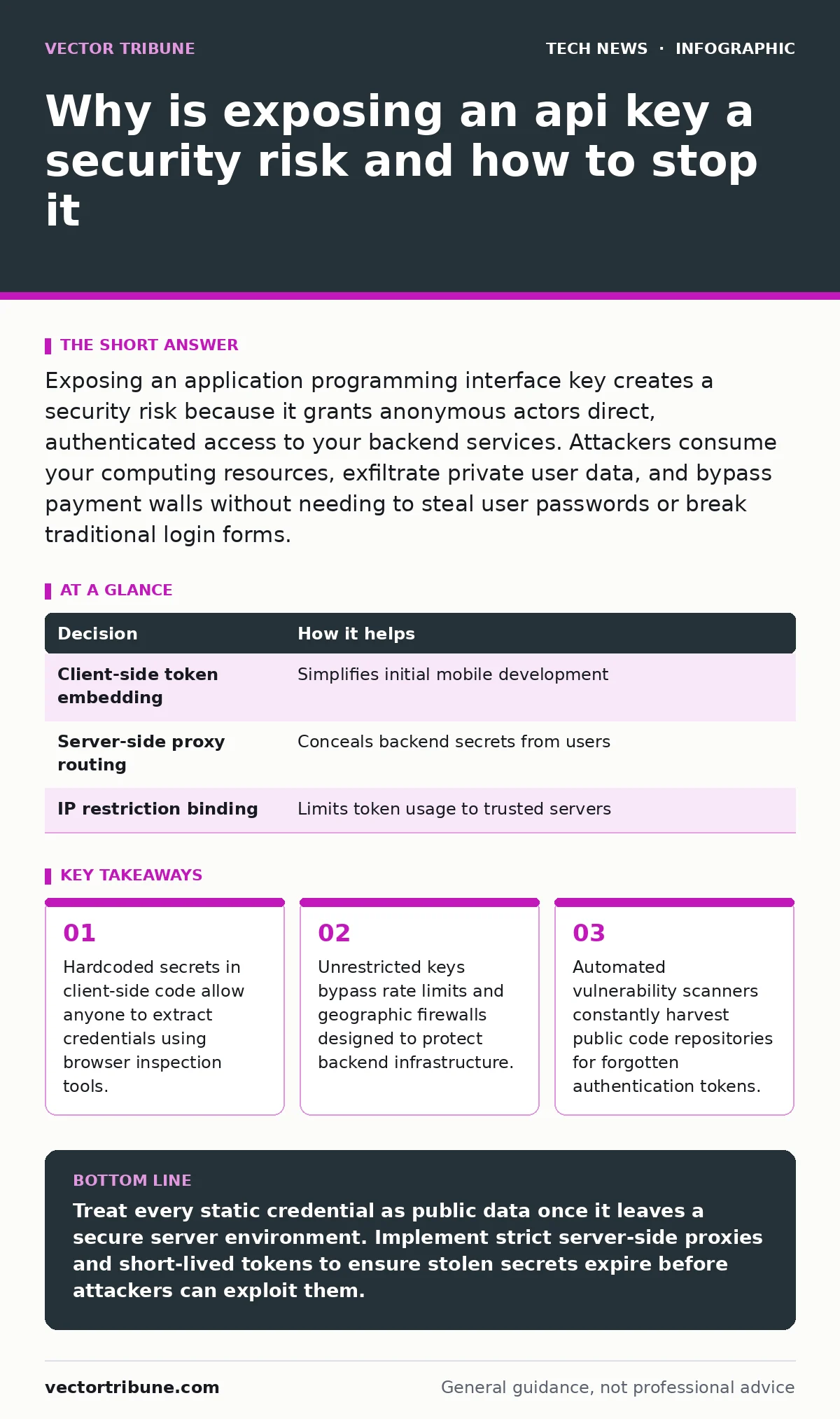
Exposing an application programming interface key creates a security risk because it grants anonymous actors direct, authenticated access to your backend services. Attackers consume your computing resources, exfiltrate private user data, and bypass payment walls without needing to steal user passwords or break traditional login forms.
Why is exposing an api key a security risk
An application programming interface key is a static string that authenticates software requests, acting as a digital master key for specific backend operations. Exposing an api key a security risk presents because authentication tokens lack the contextual awareness of human sessions. Software clients routinely ship these strings inside compiled binaries or front-end scripts, where extraction requires minimal technical effort.
Publicly accessible credentials strip away the perimeter defenses protecting your system architecture. Attackers bypass login screens, multi-factor prompts, and account lockout rules by attaching your valid token directly to raw HTTP requests. Network monitoring tools often fail to flag malicious traffic carrying a legitimate credential, masking unauthorized data extraction as standard application telemetry.
Resource exhaustion and financial drain
Unmonitored token theft immediately exposes your infrastructure to automated abuse and unexpected financial liabilities. Cloud services bill dynamically for database queries, machine learning inferences, and egress bandwidth consumed by API calls. Malicious actors deploy botnets to scrape data or train private models using your paid accounts, running up enormous cloud provider invoices before you notice the anomaly.
Rate limiting mechanisms frequently fail to protect compromised credentials because attackers distribute requests across thousands of residential proxy IP addresses. Each individual request looks like a legitimate user action, preventing automated firewalls from blocking the traffic.
| Decision | How it helps |
|---|---|
| Client-side token embedding | Simplifies initial mobile development |
| Server-side proxy routing | Conceals backend secrets from users |
| IP restriction binding | Limits token usage to trusted servers |
Privilege escalation through scope creep
Developers often generate master keys with broad administrative privileges to simplify testing across multiple microservices. Exposing an api key a security risk escalates rapidly when a single broad token unlocks user databases, payment gateways, and internal deployment pipelines simultaneously.
Least privilege principles require scoping every token to a single function and a minimal set of endpoints. Shared credentials violate this rule by granting full database read and write access to a service that only needs to send transactional emails.
Data exfiltration and compliance failures
Modern web applications aggregate sensitive personal information, proprietary code, and financial records behind guarded endpoints. Exposed authentication tokens allow automated scripts to harvest entire databases quietly over standard TLS channels.
Regulatory penalties follow swiftly when proprietary customer records leak into public forums due to weak secret management. Compliance frameworks mandate strict auditing of all data access paths, making unmonitored API tokens a severe liability during security assessments. Proper database isolation and encryption protect data at rest, but active API tokens bypass those storage controls entirely by requesting records through legitimate application logic.
Hidden costs of credential rotation
Rotating a compromised secret sounds simple, but real-world architectures complicate immediate remediation. Hardcoded tokens deployed across mobile applications cannot be updated instantly because users control when their local software updates run.
Legacy clients will break if you revoke an exposed token before every user installs a patched version. This creates a difficult dilemma between tolerating ongoing unauthorized access and intentionally crashing service availability for legitimate mobile customers.
See also: Insecure Cloud APIs: Response and Recovery Steps · Insider Data Theft Explained: How Internal Access Becomes External Risk
Prevention strategies for modern architectures
Effective secret management requires keeping authentication tokens entirely off client devices and out of public source code repositories. Environment variables loaded at runtime separate configuration from code, preventing accidental commits during rapid feature development.
Request signatures and short-lived JSON Web Tokens reduce the damage window if an interception occurs. When combined with rigorous network segmentation and proper VLANs, scoped tokens limit lateral movement across internal microservices even after a perimeter breach occurs.
Key takeaways
- Hardcoded secrets in client-side code allow anyone to extract credentials using browser inspection tools.
- Unrestricted keys bypass rate limits and geographic firewalls designed to protect backend infrastructure.
- Automated vulnerability scanners constantly harvest public code repositories for forgotten authentication tokens.
Treat every static credential as public data once it leaves a secure server environment. Implement strict server-side proxies and short-lived tokens to ensure stolen secrets expire before attackers can exploit them.
Frequently asked questions
How do attackers find hidden API keys in compiled mobile apps?
Attackers decompile application binaries into readable assembly or source code to search for hardcoded string literals and configuration files.
Can IP whitelisting protect my API keys from theft?
IP restrictions fail when attackers route requests through distributed cloud infrastructure or compromised residential proxy networks that match your allowed ranges.
What should I do immediately after discovering an exposed token?
Revoke the compromised credential instantly in your provider dashboard, inspect access logs for abnormal data exfiltration, and generate a new scoped replacement.
Why do environment variables protect secrets better than source code?
Environment variables inject secrets into the runtime memory of the server without writing them to disk or version control systems where unauthorized users might read them.
How this guide was produced: written by the Vector Tribune editorial team with AI assistance, checked against the public references listed below, and reviewed when the facts change. See our editorial policy or report an error.