
RBAC vs ABAC: The Core Differences for Secure Architecture
Attribute-based access control evaluates dynamic context like location and time, whereas role-based access control relies on static job titles and predefined permission sets.
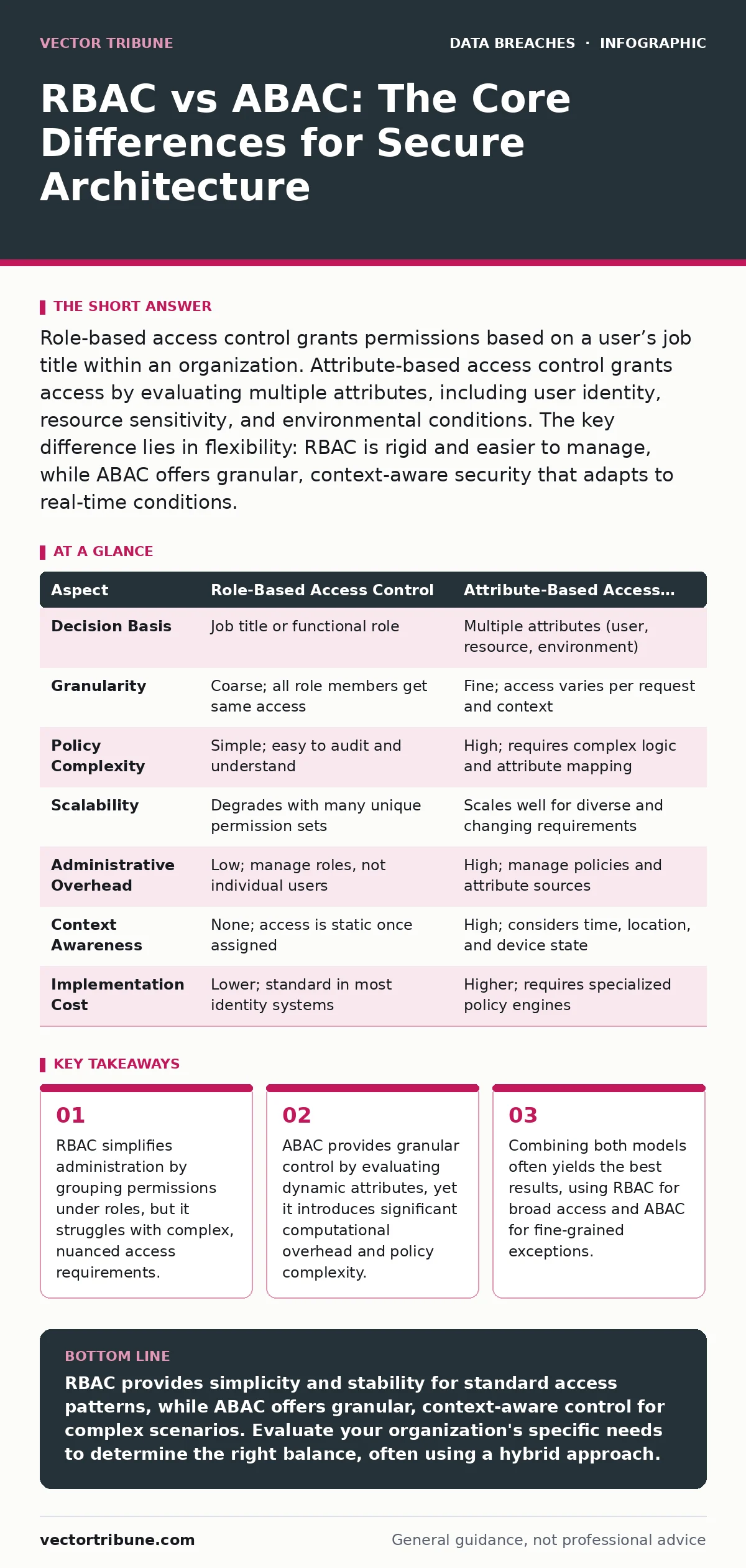
Role-based access control grants permissions based on a user’s job title within an organization. Attribute-based access control grants access by evaluating multiple attributes, including user identity, resource sensitivity, and environmental conditions. The key difference lies in flexibility: RBAC is rigid and easier to manage, while ABAC offers granular, context-aware security that adapts to real-time conditions.
The Fundamental Distinction Between Access Models
Role-based access control (RBAC) assigns permissions to roles, and users inherit those permissions by assuming the role. This model assumes that job function is the primary determinant of access needs. Attribute-based access control (ABAC) evaluates a set of attributes to make an access decision. These attributes can include user properties, resource characteristics, and environmental factors. The core difference is static versus dynamic evaluation. RBAC checks if a user holds a specific label. ABAC calculates whether the current context satisfies a complex policy.
Imagine a system where a user needs access to a file only during business hours from a corporate network. RBAC cannot easily enforce this without creating dozens of overlapping roles. ABAC evaluates the time and network location as part of the decision logic. This makes ABAC superior for dynamic environments but significantly harder to implement correctly.
| Aspect | Role-Based Access Control | Attribute-Based Access Control |
|---|---|---|
| Decision Basis | Job title or functional role | Multiple attributes (user, resource, environment) |
| Granularity | Coarse; all role members get same access | Fine; access varies per request and context |
| Policy Complexity | Simple; easy to audit and understand | High; requires complex logic and attribute mapping |
| Scalability | Degrades with many unique permission sets | Scales well for diverse and changing requirements |
| Administrative Overhead | Low; manage roles, not individual users | High; manage policies and attribute sources |
| Context Awareness | None; access is static once assigned | High; considers time, location, and device state |
| Implementation Cost | Lower; standard in most identity systems | Higher; requires specialized policy engines |
When Static Roles Suffice
Choose RBAC when your organization has well-defined job functions and stable permission requirements. This model works best in environments where the principle of least privilege can be achieved through broad role assignments. It is the standard for most enterprise applications because it is intuitive for administrators and users. The simplicity of RBAC reduces the risk of misconfiguration. When a new employee joins, you assign them a role, and they inherit the necessary permissions. This process is repeatable and auditable.
RBAC is also preferable when regulatory compliance requires clear, documented lines of authority. Auditors can easily trace why a user has access by looking at their role assignment. The model prevents the proliferation of individual permissions, which often leads to privilege creep. If your data access patterns do not change frequently, RBAC provides a stable and secure foundation. It minimizes the computational load on identity providers because the decision is a simple lookup.
- Define clear role hierarchies that reflect actual job responsibilities.
- Review role permissions quarterly to remove unnecessary access.
- Use group membership to manage role assignments efficiently.
When Dynamic Context Demands Precision
Choose ABAC when access decisions depend on factors that change frequently. This includes time of day, geographic location, device security posture, or data sensitivity levels. ABAC is necessary when you need to enforce policies that RBAC cannot express without creating an unmanageable number of roles. For example, if a user can only access financial data from a corporate laptop during business hours, ABAC evaluates these conditions in real time.
This model is critical for protecting sensitive data in cloud environments where users access resources from various locations and devices. It allows for zero-trust architectures by verifying trust continuously rather than at login. ABAC supports complex business rules that require multiple conditions to be met simultaneously. However, it requires a robust policy engine and well-defined attribute sources. The complexity of ABAC means that errors in policy logic can lead to unexpected access denials or grants.
- Identify all attributes that influence access decisions.
- Ensure attribute sources are reliable and up to date.
- Test policies thoroughly to avoid unintended access blocks.
The Overlap and Hybrid Approaches
Many organizations use a hybrid approach that combines the strengths of both models. RBAC handles the bulk of access decisions, providing a stable baseline. ABAC is used for exceptions and fine-grained controls. This reduces the complexity of ABAC policies while still allowing for dynamic evaluation. For instance, a user might have a role that grants general access to a database, but ABAC policies restrict access to specific rows based on department.
This overlap is common in modern identity and access management systems. The system uses RBAC to determine if a user is eligible for access, then applies ABAC to refine the decision. This layered approach balances security and usability. It prevents the administrative burden of managing thousands of ABAC policies for every single request. Instead, ABAC is reserved for high-risk or highly sensitive operations.
Hidden Costs of Policy Complexity
A non-obvious consequence of ABAC is the increased latency in access decisions. Evaluating multiple attributes in real time requires more processing power than a simple role lookup. In high-throughput systems, this can become a bottleneck. Another hidden cost is the difficulty in debugging access issues. When a user is denied access, determining which attribute failed can be challenging without detailed logging.
RBAC has its own hidden costs, particularly in large organizations with many overlapping roles. Role explosion occurs when new roles are created for every minor variation in access needs. This leads to a fragmented permission model that is difficult to audit. Both models require ongoing maintenance. Permissions drift over time as job functions change, leading to privilege creep if not regularly reviewed.
See also: 7 Deepfake Mistakes That Leave Your Organization Vulnerable
Integration with Broader Security Practices
Access control does not exist in isolation. It must work alongside other security measures to provide effective protection. For instance, even with strict access controls, lost and stolen devices can pose a risk if the device itself is not encrypted. Implementing full disk encryption ensures that data remains secure even if physical access is gained. Similarly, insider data theft can occur if users have legitimate access but misuse it. Access control limits what data they can see, but monitoring detects misuse.
Third-party vendors often require access to your systems, introducing additional risks. Third-party data breaches can result from weak access controls granted to external partners. Using ABAC can help enforce strict conditions on third-party access, such as limiting it to specific time windows or IP ranges. Additionally, social engineering attacks can lead to misdirected emails that expose sensitive information. Clear access policies help users understand what data they should share and with whom.
Avoiding Common Implementation Pitfalls
A common mistake is assuming that ABAC eliminates the need for role management. Roles are still useful for grouping users and simplifying policy creation. Another pitfall is creating overly complex ABAC policies that are difficult to understand and maintain. Policies should be modular and well-documented. Regular testing is essential to ensure that policies work as intended.
RBAC implementations often suffer from role sprawl, where too many roles are created. This makes it difficult to manage and audit access. Regularly review and consolidate roles to keep the model simple. Both models require clear governance. Define who can create and modify roles and policies. Ensure that changes are reviewed and approved by the appropriate stakeholders.
Key takeaways
- RBAC simplifies administration by grouping permissions under roles, but it struggles with complex, nuanced access requirements.
- ABAC provides granular control by evaluating dynamic attributes, yet it introduces significant computational overhead and policy complexity.
- Combining both models often yields the best results, using RBAC for broad access and ABAC for fine-grained exceptions.
RBAC provides simplicity and stability for standard access patterns, while ABAC offers granular, context-aware control for complex scenarios. Evaluate your organization's specific needs to determine the right balance, often using a hybrid approach.
Frequently asked questions
Can RBAC and ABAC be used together?
Yes, many organizations use a hybrid model where RBAC handles broad access and ABAC refines it for specific conditions.
Which model is better for cloud environments?
ABAC is often preferred for cloud environments due to its ability to handle dynamic contexts and diverse access patterns.
How do I prevent role sprawl in RBAC?
Regularly review and consolidate roles, ensuring they align with actual job functions and principles of least privilege.
What are the main challenges of implementing ABAC?
Challenges include policy complexity, increased latency, and the need for reliable attribute sources and robust policy engines.
How this guide was produced: written by the Vector Tribune editorial team with AI assistance, checked against the public references listed below, and reviewed when the facts change. See our editorial policy or report an error.