
Encryption Key Management Errors: 6 Common Misunderstandings and Fixes
Storing encryption keys alongside encrypted data renders the cryptographic protection useless and creates a single point of failure for attackers.
Developers often mistake key storage for key management. You must separate keys from data, rotate them regularly, and restrict access. Misunderstanding these boundaries leads to data exposure even when strong algorithms are in use. Proper key lifecycle management prevents unauthorized decryption.
Misreading: Keys Are Just Long Passwords
Correct reading: Encryption keys differ from passwords in structure and usage. Passwords are short, memorable strings that humans type. Encryption keys are long, random bit sequences that machines process. You should never derive encryption keys directly from user passwords without a key derivation function. A key derivation function slows down brute-force attacks by adding computational cost. Treating keys as passwords leads to weak entropy. Weak entropy means attackers can guess the key. You must generate keys using a cryptographically secure random number generator. This ensures maximum unpredictability.
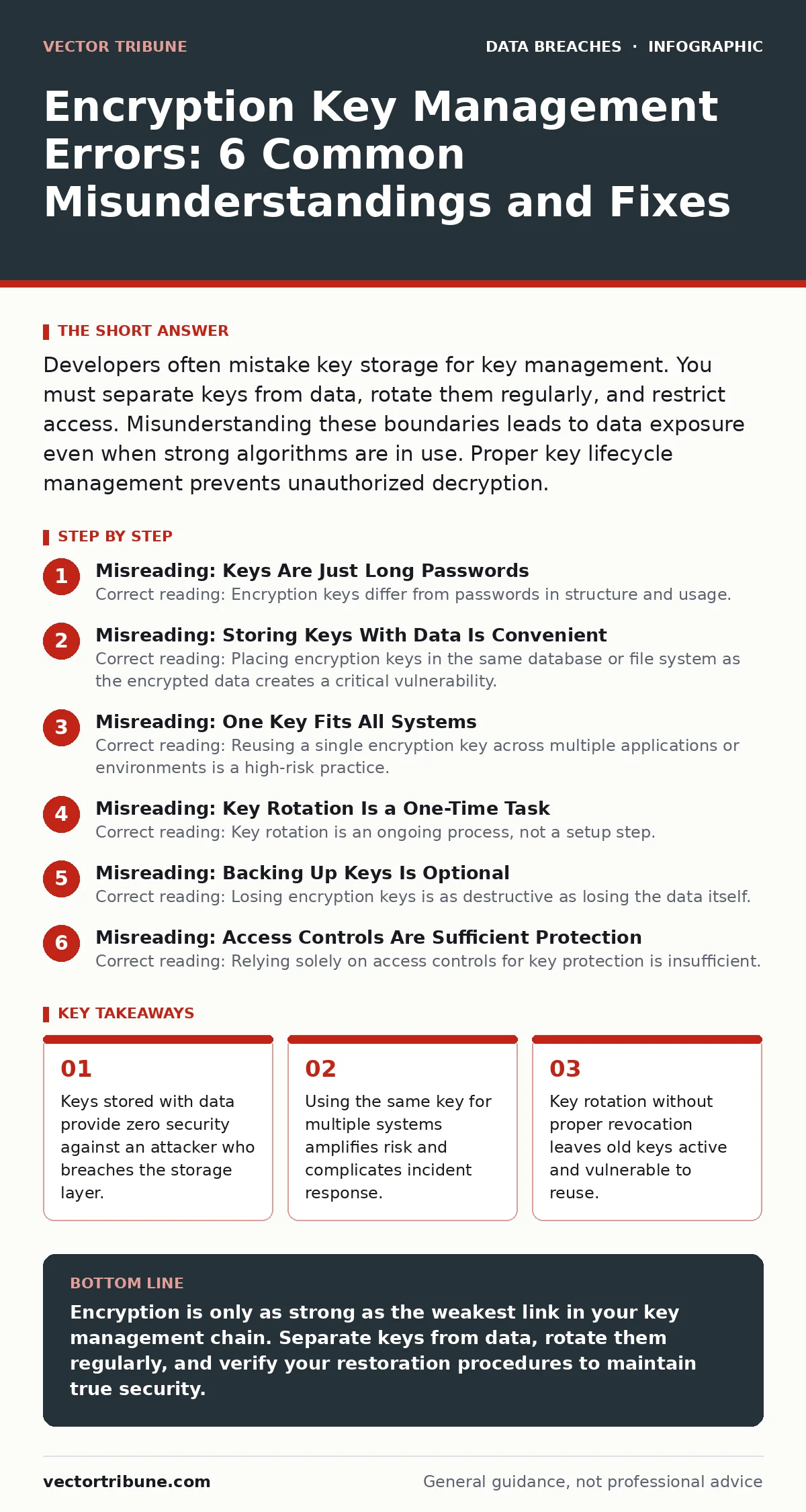
Misreading: Storing Keys With Data Is Convenient
Correct reading: Placing encryption keys in the same database or file system as the encrypted data creates a critical vulnerability. If an attacker breaches the storage layer, they obtain both the lock and the key. This defeats the purpose of encryption. You must implement strict separation of duties. Store keys in a dedicated key management system or hardware security module. A hardware security module is a physical device that safeguards and manages digital keys. This isolation ensures that a database breach does not automatically lead to data decryption. Refer to the guidance on encryption at rest for architectural patterns that enforce this separation.
Misreading: One Key Fits All Systems
Correct reading: Reusing a single encryption key across multiple applications or environments is a high-risk practice. If one system is compromised, the attacker can decrypt data in all other systems using the same key. This is known as key reuse. You must assign unique keys to each distinct dataset or application. This limits the blast radius of a breach. Key isolation ensures that a compromise in one module does not expose the entire infrastructure. It also simplifies key rotation. You can rotate a key for one application without disrupting others. This modular approach enhances overall security posture.
Misreading: Key Rotation Is a One-Time Task
Correct reading: Key rotation is an ongoing process, not a setup step. Keys must be replaced at regular intervals or after specific events. Events include suspected compromise or employee departure. Failure to rotate keys means old keys remain valid indefinitely. Attackers who capture old keys can decrypt historical data.
You must implement a key versioning strategy. This allows the system to decrypt data encrypted with older keys while using new keys for new data. Proper rotation reduces the window of exposure. It also limits the amount of data exposed if a key is leaked. See the section on lost and stolen devices for examples of how static keys increase risk during physical loss.
Misreading: Backing Up Keys Is Optional
Correct reading: Losing encryption keys is as destructive as losing the data itself. If you lose the key, the data becomes permanently inaccessible. This is called crypto-shredding. You must back up keys securely. Backups must be encrypted with a different key. This prevents a single backup breach from exposing all keys.
Store backups in geographically separate locations. This protects against regional disasters. Test the restoration process regularly. A backup that cannot be restored is useless. Verify that your recovery procedure works before an incident occurs. This ensures business continuity. Refer to ISO 27001 standards for requirements on backup integrity and availability.
See also: What Does Full Disk Encryption Protect Against: A Technical Deep Dive · Misdirected Email Response: Containment and Recovery Steps
Misreading: Access Controls Are Sufficient Protection
Correct reading: Relying solely on access controls for key protection is insufficient. Access controls manage who can request a key, but they do not protect the key itself. You must combine access controls with cryptographic protections. Use multi-factor authentication for key management consoles. Implement role-based access control.
This limits who can view or use keys. Audit all key usage. Log every access attempt. Monitor for anomalous patterns. Detecting unusual behavior helps identify insider threats. See the guide on insider data theft for strategies to monitor privileged access. Combining technical and administrative controls provides defense in depth.
Misreading: Third-Party Providers Handle All Risks
Correct reading: Using a cloud provider or third-party service does not eliminate your responsibility for key management. Many providers offer managed key services, but you often retain control over key policies. You must understand the shared responsibility model. The provider secures the infrastructure, but you secure the keys and data.
Verify how the provider handles key rotation and backup. Ensure you have the ability to export keys if needed. Vendor lock-in can prevent key retrieval. Maintain control over your cryptographic material. Refer to third-party data breaches for insights on supply chain risks. Trust but verify the security practices of any external service.
Key takeaways
- Keys stored with data provide zero security against an attacker who breaches the storage layer.
- Using the same key for multiple systems amplifies risk and complicates incident response.
- Key rotation without proper revocation leaves old keys active and vulnerable to reuse.
Encryption is only as strong as the weakest link in your key management chain. Separate keys from data, rotate them regularly, and verify your restoration procedures to maintain true security.
Frequently asked questions
How often should I rotate encryption keys?
Rotate keys based on risk assessment and regulatory requirements. Common intervals are annually or after significant personnel changes.
Can I use the same key for hashing and encryption?
No. Use distinct keys for different cryptographic functions. Reusing keys for multiple purposes can lead to cryptographic failures and data leakage.
What is a hardware security module?
A hardware security module is a dedicated physical device that generates, stores, and manages cryptographic keys. It provides tamper resistance and secure key processing.
How do I test my key management?
Simulate a key loss scenario. Attempt to restore data using backup keys. Verify that the process works within your recovery time objectives.
How this guide was produced: written by the Vector Tribune editorial team with AI assistance, checked against the public references listed below, and reviewed when the facts change. See our editorial policy or report an error.