
Why Is Encryption At Rest Important For Data Security
Encryption at rest transforms readable data into unreadable code, ensuring that physical theft of storage media yields only useless mathematical noise rather than sensitive information.
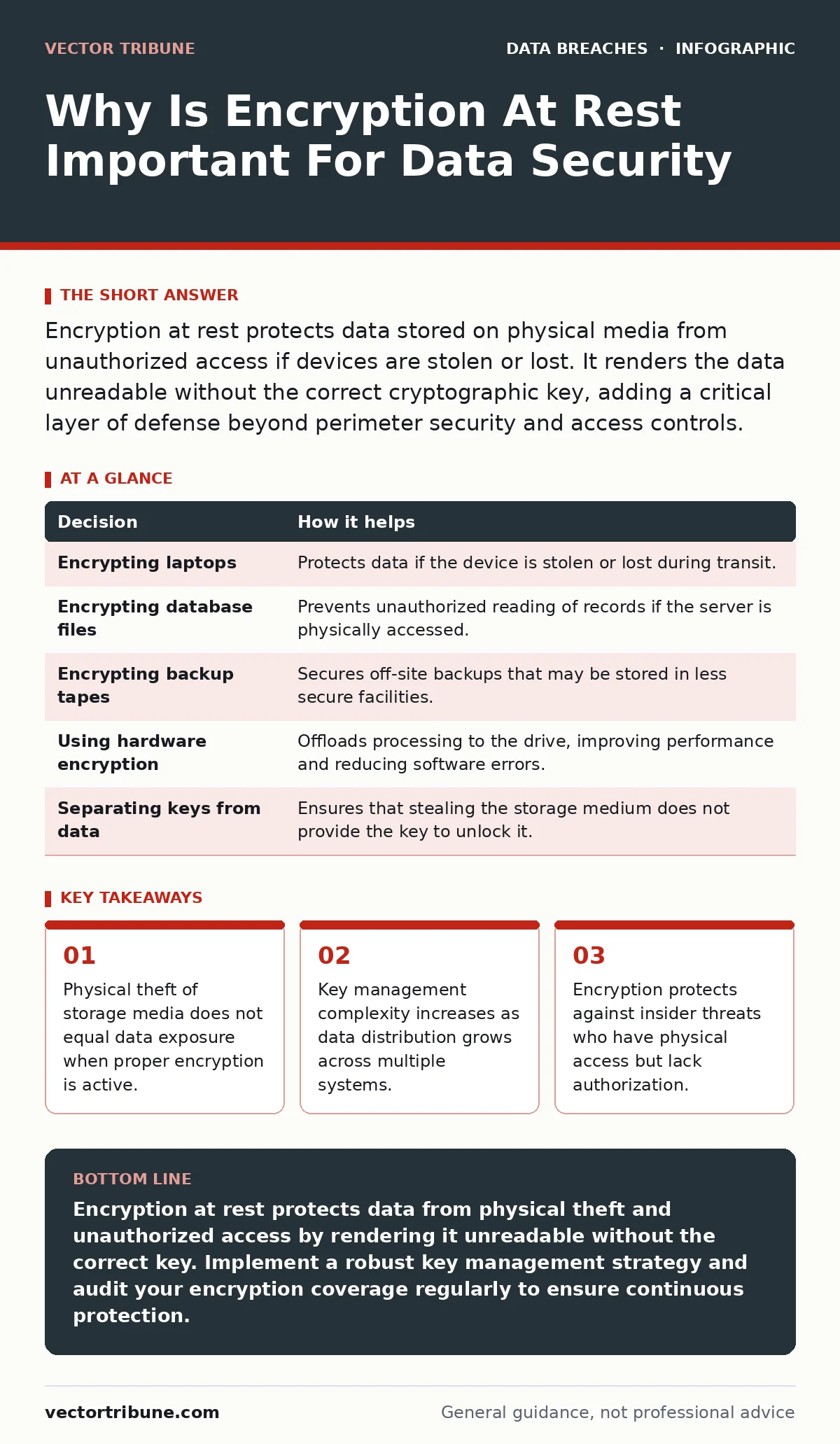
Encryption at rest protects data stored on physical media from unauthorized access if devices are stolen or lost. It renders the data unreadable without the correct cryptographic key, adding a critical layer of defense beyond perimeter security and access controls.
Why Is Encryption At Rest Important
Encryption at rest transforms readable data into unreadable code, ensuring that physical theft of storage media yields only useless mathematical noise rather than sensitive information. You need this protection because perimeter defenses can fail, and physical security is never absolute. When an attacker gains physical possession of a hard drive, database server, or backup tape, traditional access controls become irrelevant.
The attacker bypasses the network firewall and the application login screen entirely. They connect the storage device directly to a working system and read the raw files. Without encryption, every record, every credential, and every document is exposed in plain text. This is the primary reason why encryption at rest matters: it decouples physical possession from data access. You control the data through keys, not through the box it sits in.
The Mechanics Of Storage Protection
Encryption at rest works by applying a cryptographic algorithm to data before it writes to the storage medium. The most common approach uses symmetric encryption, where the same key encrypts and decrypts the data. This method is fast and efficient for large volumes of data. The system handles the encryption and decryption processes transparently, so applications do not need to change their code. The operating system or the storage hardware manages the cryptographic operations.
This transparency is a double-edged sword. It ensures adoption because it requires minimal effort from developers. It also means that if the operating system is compromised, the encryption layer might be bypassed. The security depends entirely on the secrecy and integrity of the encryption key, not the complexity of the algorithm. If an attacker obtains the key, the encryption provides no benefit.
What Goes Wrong Without It
When you skip encryption at rest, you assume that physical security is perfect. This assumption fails when devices are lost, stolen, or improperly disposed of. A laptop left in a taxi or a hard drive sold to a recycler becomes a goldmine for attackers. They do not need sophisticated hacking tools. They need a cable and a working computer. The damage extends beyond the immediate loss of data.
Regulatory compliance often mandates encryption for certain types of information. Failing to encrypt can lead to legal penalties and loss of customer trust. Even if no one steals the device, insider threats pose a risk. An employee with physical access to a server room can remove a hard drive and copy its contents. Encryption at rest stops this type of theft because the employee cannot read the data without the key.
| Decision | How it helps |
|---|---|
| Encrypting laptops | Protects data if the device is stolen or lost during transit. |
| Encrypting database files | Prevents unauthorized reading of records if the server is physically accessed. |
| Encrypting backup tapes | Secures off-site backups that may be stored in less secure facilities. |
| Using hardware encryption | Offloads processing to the drive, improving performance and reducing software errors. |
| Separating keys from data | Ensures that stealing the storage medium does not provide the key to unlock it. |
The Hidden Cost Of Key Management
Encryption introduces a new dependency: the encryption key. If you lose the key, you lose the data permanently. This is a non-obvious consequence of encryption. Many organizations focus on securing the data but neglect the lifecycle of the keys. Keys must be generated, stored, rotated, and destroyed securely. If you store the key on the same device as the data, you have not gained much security.
The key must be isolated. This adds complexity to your infrastructure. You need a key management system that is available when you need to decrypt data. If the key management server goes down, your applications cannot read the encrypted data. This creates a single point of failure. You trade physical theft risk for availability risk. Balancing these two risks requires careful planning and testing.
Edge Cases And Common Failures
Encryption at rest is not a magic shield. It fails when implemented incorrectly. One common mistake is encrypting the data but leaving the encryption keys in plain text within the application configuration files. This is equivalent to not encrypting at all. Another failure point is temporary files. Some applications write sensitive data to temporary storage before encrypting it.
If the system crashes or the process is interrupted, the unencrypted data may remain on the disk. You must ensure that all sensitive data is encrypted before it touches any storage medium. This includes swap files, crash dumps, and temporary caches. Review your application’s data flow to identify where data exists in plain text. Encrypting the database is not enough if the application logs sensitive data in plain text files.
See also: Encryption in a Sentence: How Scrambling Data Protects Your Digital Life · Misdirected Email Response: Containment and Recovery Steps
Integrating With Broader Security
Encryption at rest is one layer of a deeper security strategy. It does not replace access controls, network security, or application security. It complements them. You should view encryption as the last line of defense. If all other controls fail, encryption prevents data exposure. This aligns with the principle of defense in depth. You can read more about this approach in our guide on data breaches.
Understanding how different layers interact helps you prioritize your security investments. For example, if you have strong network security but weak physical security, encryption at rest becomes more critical. If you have strong physical security but weak application security, you might focus on input validation and access controls instead. Context determines the weight of each control.
What To Do With This Knowledge
Start by identifying where your sensitive data resides. Map out all storage locations, including databases, file servers, laptops, and backup systems. Determine which data requires encryption based on its sensitivity and regulatory requirements. Choose an encryption method that fits your performance needs and security goals. Hardware encryption is easier to manage but offers less control.
Software encryption provides more flexibility but requires more resources. Implement a key management strategy that separates keys from data. Test your recovery procedures regularly. Ensure that you can decrypt data when needed and that you can rotate keys without downtime. Monitor your encryption status to detect any gaps. Encryption at rest is a continuous process, not a one-time setup.
Key takeaways
- Physical theft of storage media does not equal data exposure when proper encryption is active.
- Key management complexity increases as data distribution grows across multiple systems.
- Encryption protects against insider threats who have physical access but lack authorization.
Encryption at rest protects data from physical theft and unauthorized access by rendering it unreadable without the correct key. Implement a robust key management strategy and audit your encryption coverage regularly to ensure continuous protection.
Frequently asked questions
Does encryption at rest protect against ransomware?
No, encryption at rest does not prevent ransomware from encrypting your files. Ransomware encrypts data while the system is running, often before the storage encryption layer sees it. You need backups and endpoint protection to defend against ransomware.
Is hardware encryption better than software encryption?
Hardware encryption is easier to manage and has less performance impact, but it offers less control and visibility. Software encryption provides more flexibility and auditability but requires more processing power. Choose based on your specific security and performance needs.
How often should I rotate encryption keys?
Key rotation frequency depends on your risk tolerance and regulatory requirements. A common practice is to rotate keys annually or when a key is suspected to be compromised. Regular rotation limits the amount of data exposed if a key is stolen.
Can I encrypt data in transit and at rest with the same key?
It is generally better to use different keys for data in transit and data at rest. This separation of duties limits the impact of a key compromise. If one key is stolen, the attacker cannot decrypt both stored data and network traffic.
How this guide was produced: written by the Vector Tribune editorial team with AI assistance, checked against the public references listed below, and reviewed when the facts change. See our editorial policy or report an error.