
Shared AI Chat Links in Search Results: Prevention Checklist
Public web indexers crawl ephemeral conversation endpoints when creators unintentionally publish session sharing tokens.
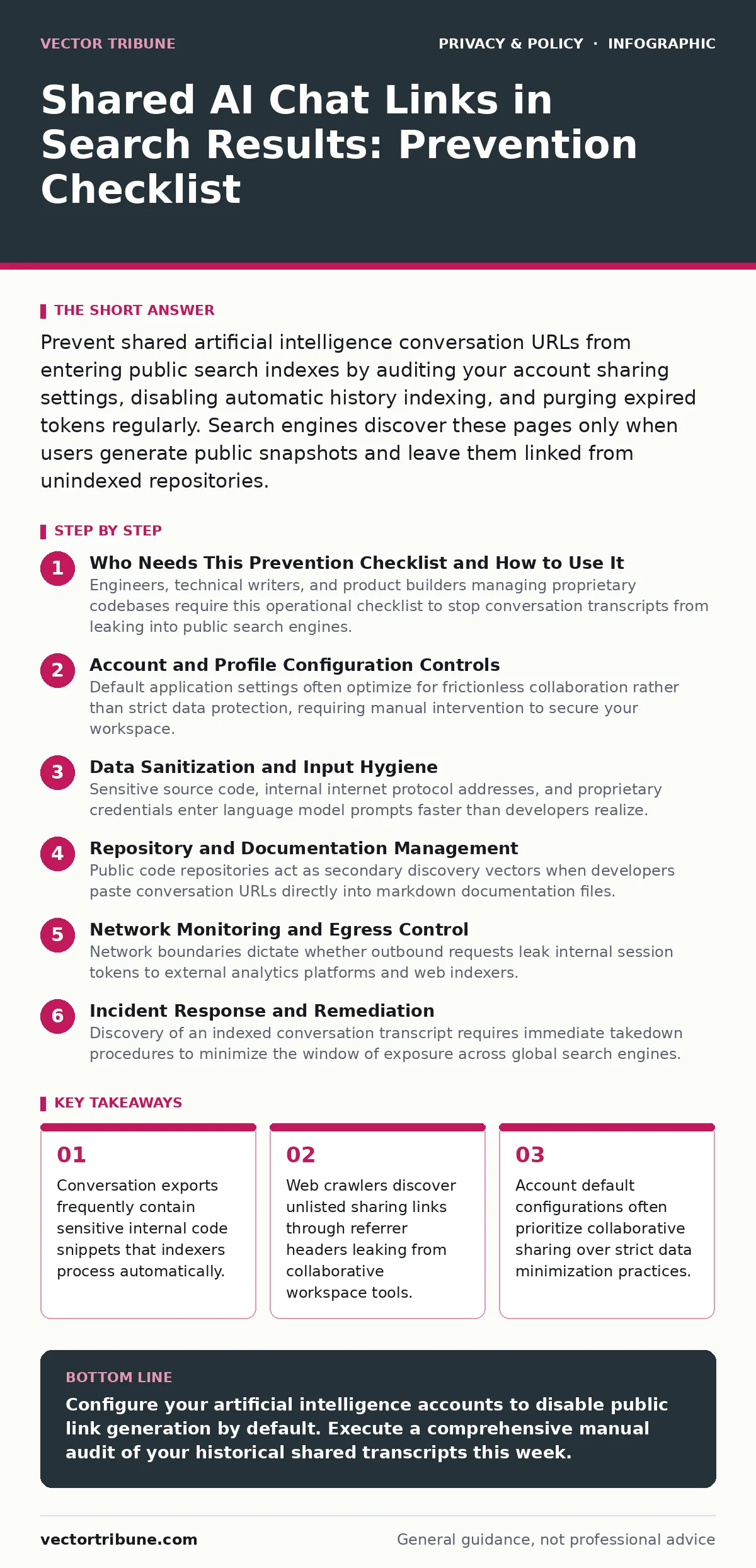
Prevent shared artificial intelligence conversation URLs from entering public search indexes by auditing your account sharing settings, disabling automatic history indexing, and purging expired tokens regularly. Search engines discover these pages only when users generate public snapshots and leave them linked from unindexed repositories.
Who Needs This Prevention Checklist and How to Use It
Engineers, technical writers, and product builders managing proprietary codebases require this operational checklist to stop conversation transcripts from leaking into public search engines. Work through the grouped verification items sequentially during your routine security audits, treating each unchecked box as an active vulnerability vector for accidental data exposure.
Account and Profile Configuration Controls
Default application settings often optimize for frictionless collaboration rather than strict data protection, requiring manual intervention to secure your workspace. Enterprise environments implement privacy by design principles, but individual user accounts frequently expose chat histories through loose sharing permissions.
- Disable automatic link generation: stops conversational interfaces from creating public URLs upon export.
- Revoke active public tokens: invalidates historical session snapshots currently residing in web caches.
- Restrict workspace membership lists: limits internal transcript discovery among unauthorized third-party collaborators.
- Enforce session expiration limits: forces shared chat links to self-destruct after 24 hours of inactivity.
Data Sanitization and Input Hygiene
Sensitive source code, internal internet protocol addresses, and proprietary credentials enter language model prompts faster than developers realize. Neglecting basic data hygiene transforms a private debugging session into a public indexing hazard when a share button is clicked out of habit.
- Strip API keys from prompts: prevents authentication secrets from appearing in text payloads destined for cloud storage.
- Generalize variable names: replaces internal server designations with generic placeholders before initiating a chat session.
- Apply local pseudonymization routines: obscures customer identifiers and database schemas prior to pasting logs into remote systems.
- Verify output persistence states: confirms that generated text snippets are not tied to a permanent web-accessible identifier.
Repository and Documentation Management
Public code repositories act as secondary discovery vectors when developers paste conversation URLs directly into markdown documentation files. Search engine spiders harvest these markdown files from open-source projects, indexing the referenced chat transcripts instantly.
- Scan documentation for shared URLs: removes accidental markdown links pointing to conversational debugging sessions.
- Implement automated link checkers: flags outbound hypertext transfer protocol references inside public code repositories during continuous integration builds.
- Configure robots exclusion files: instructs web crawlers to ignore specific directories where administrative logs might accumulate.
- Audit commit history logs: purges historical repository revisions that contained exposed conversational sharing endpoints.
Network Monitoring and Egress Control
Network boundaries dictate whether outbound requests leak internal session tokens to external analytics platforms and web indexers. Developers working remotely frequently bypass corporate proxy boundaries, exposing unencrypted query parameters over insecure network connections that monitor traffic patterns.
- Inspect browser extension permissions: blocks malicious helper tools from scraping active browser DOM trees for session tokens.
- Restrict outbound webhook destinations: prevents automated integration scripts from broadcasting internal chat identifiers to public endpoints.
- Monitor DNS query logs: identifies unexpected outbound traffic destined for known web crawler ingestion servers.
- Disable automatic referrer transmission: stops modern browsers from leaking full Uniform Resource Locators to external domains via HTTP headers.
Incident Response and Remediation
Discovery of an indexed conversation transcript requires immediate takedown procedures to minimize the window of exposure across global search engines. Removal requests depend on controlling the underlying hosting server response headers rather than simply deleting the original local file.
- Issue immediate HTTP four hundred ten status codes: signals search engine crawlers that the shared resource has been permanently deleted.
- Request manual search index removal: submits direct URL purging forms to major search engine administrators.
- Rotate compromised internal credentials: invalidates any database passwords or service tokens exposed within the leaked transcript text.
- Broadcast internal security advisories: notifies engineering peers to check their own accounts for similar inadvertent link generation.
Key takeaways
- Conversation exports frequently contain sensitive internal code snippets that indexers process automatically.
- Web crawlers discover unlisted sharing links through referrer headers leaking from collaborative workspace tools.
- Account default configurations often prioritize collaborative sharing over strict data minimization practices.
Configure your artificial intelligence accounts to disable public link generation by default. Execute a comprehensive manual audit of your historical shared transcripts this week.
Frequently asked questions
How do search engines discover unlisted chat transcripts if nobody publishes the links directly?
Web crawlers find unlisted URLs through browser history sharing, leaked referrer headers from collaborative coding tools, and accidental inclusion in public code repositories.
Do privacy-focused browser extensions prevent conversational sharing links from leaking?
Browser extensions block outbound telemetry and referrer headers, but they cannot stop you from manually clicking a button that generates a public web snapshot on a remote server.
What specific server response header forces a search engine to drop an indexed chat page immediately?
Returning a permanent removal status code combined with a noindex directive forces crawlers to drop the cached page during their next scheduled re-indexing cycle.
Can enterprise management consoles disable sharing features across all employee accounts?
Enterprise administrators enforce global policy controls that strip out public sharing capabilities across organizational user profiles entirely.
How this guide was produced: written by the Vector Tribune editorial team with AI assistance, checked against the public references listed below, and reviewed when the facts change. See our editorial policy or report an error.