
Secure DNS benefits and limitations: what encryption changes
Encrypting domain name requests stops local eavesdropping, but hands routing metadata to centralized cloud providers.
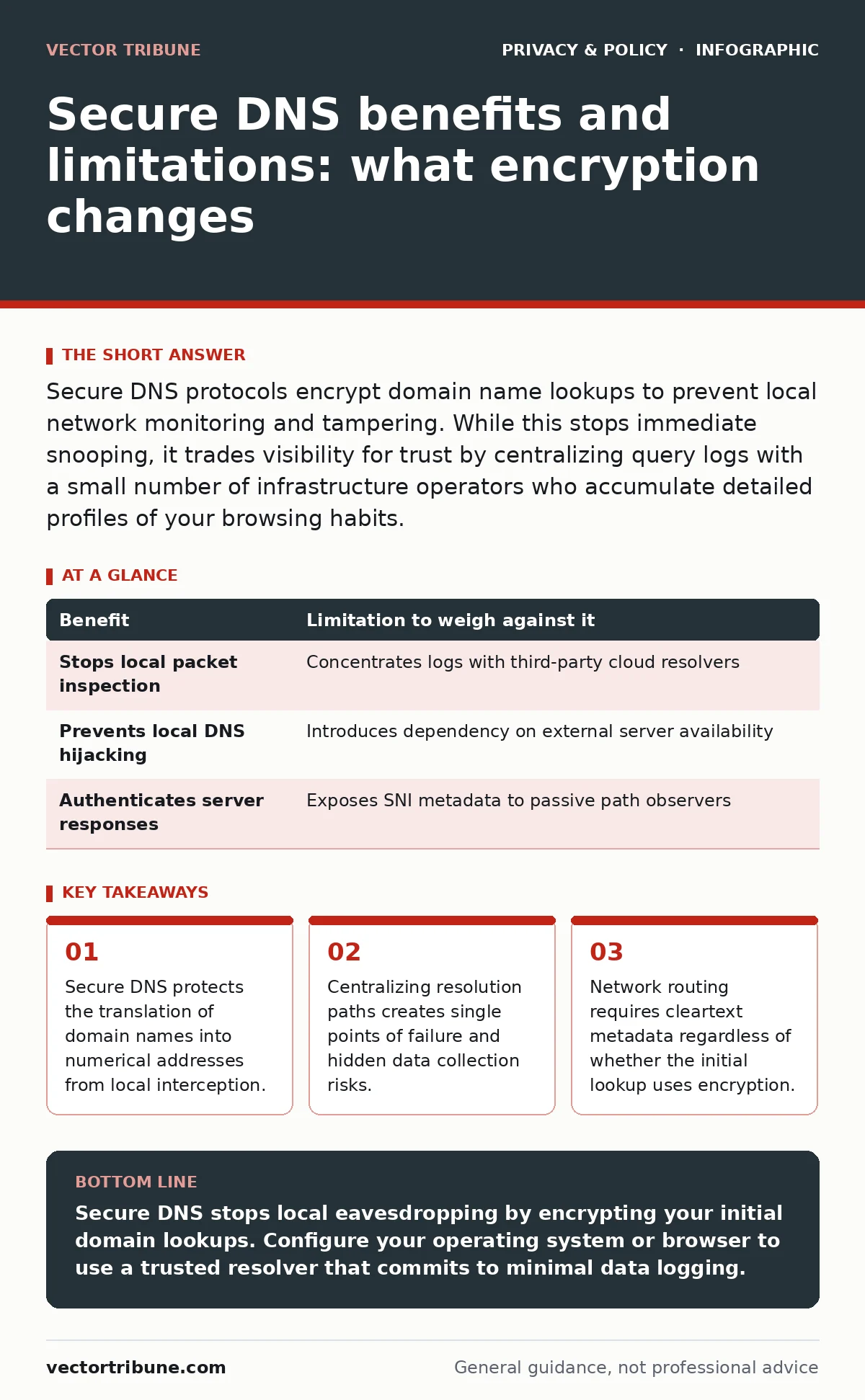
Secure DNS protocols encrypt domain name lookups to prevent local network monitoring and tampering. While this stops immediate snooping, it trades visibility for trust by centralizing query logs with a small number of infrastructure operators who accumulate detailed profiles of your browsing habits.
How secure DNS protects lookups
Domain name resolution translates human-readable web addresses into numerical internet protocol addresses. Traditional resolution sends these requests in cleartext over the local network, allowing any intermediary device to read your destination. Secure DNS protocols wrap these queries in cryptographic transport layers like Transport Layer Security, ensuring local network observers see only random data rather than plain text domain names.
Preventing local interception stops intrusive network administrators and local internet service providers from cataloging every site you visit. Local routing hardware often injects ads or redirects failed lookups into search portals by manipulating standard name resolution traffic. Cryptographic verification of server responses ensures that the numerical address returned matches the genuine record published by the domain owner rather than a forged reply.
Trade-offs of centralized resolution
Centralized infrastructure providers handle massive volumes of encrypted name resolution requests across the global internet. Routing your queries through these massive third-party resolvers concentrates vast amounts of browsing data into single commercial entities. Hidden costs emerge when these operators aggregate your traffic patterns, substituting local surveillance with remote tracking that bypasses traditional network boundaries.
Centralized operators promise strict data minimization policies, yet technical enforcement remains entirely outside your control. Trusting an external entity requires believing their operational promises regarding data retention and logging practices. Independent network architects often pair name encryption with pseudonymization techniques to sever the permanent link between a specific machine and its outbound lookup requests.
Comparing benefits and limitations
Direct comparison reveals the operational compromises inherent in adopting cryptographic name resolution protocols. Every technical advantage introduces a corresponding operational dependency that alters your overall threat model.
| Benefit | Limitation to weigh against it |
|---|---|
| Stops local packet inspection | Concentrates logs with third-party cloud resolvers |
| Prevents local DNS hijacking | Introduces dependency on external server availability |
| Authenticates server responses | Exposes SNI metadata to passive path observers |
Performance and latency impacts
Establishing cryptographic sessions for every domain lookup adds computational overhead and network round trips. Initial handshakes require extra packet exchanges before the actual resolution can occur, potentially slowing down initial page load times on distant connections. Connection pooling and session resumption mitigate this overhead, but poor network conditions expose the raw latency cost of maintaining encrypted control channels.
Fallback mechanisms present another subtle failure mode when encrypted resolvers become unreachable due to routing failures. Systems often revert automatically to unencrypted local resolvers when primary encrypted endpoints fail, silently exposing your traffic without explicit notification. This silent fallback defeats the primary privacy guarantee during network transitions or localized outages.
When it is worth it
Adopting encrypted resolution makes sense when you operate on untrusted local infrastructure where network operators actively inspect or manipulate traffic. Imagine connecting your development laptop to a hospitality network that injects malicious scripts into unencrypted web streams. Encrypting name lookups blocks local tampering attempts and preserves the integrity of your initial connection handshakes.
Remote workers traveling through restrictive regional networks benefit heavily from cryptographic transport mechanisms that bypass local censorship attempts. Circumventing arbitrary domain blocks allows you to reach development resources and documentation sites without localized interference. This setup works exceptionally well when combined with public Wi-Fi risks mitigations to secure your entire transport layer against hostile local proxies.
See also: Private File Sharing Services: How Secure Transfers Work · Shared AI Chat Links in Search Results: Prevention Checklist
When it is not worth it
Deploying encrypted resolution provides little defensive value if your browser leaks the target domain through unencrypted protocol extensions during the subsequent connection phase. Modern web browsing exposes the destination hostname in cleartext during the transport layer handshake long before the encrypted HTTP session begins. This residual leakage means that passive observers on the wider network path still learn your exact destination regardless of how you resolved the domain name.
Corporate environments governed by strict compliance mandates often require internal name resolution paths to function correctly. Enforcing custom internal routing rules for proprietary development servers breaks when queries leave the local perimeter and resolve against public cloud providers.
Corporate networks also rely on local visibility to enforce security policies and detect anomalous outbound traffic patterns. Integrating privacy by design principles into internal architecture requires balancing employee data expectations against necessary infrastructure monitoring controls.
Key takeaways
- Secure DNS protects the translation of domain names into numerical addresses from local interception.
- Centralizing resolution paths creates single points of failure and hidden data collection risks.
- Network routing requires cleartext metadata regardless of whether the initial lookup uses encryption.
Secure DNS stops local eavesdropping by encrypting your initial domain lookups. Configure your operating system or browser to use a trusted resolver that commits to minimal data logging.
Frequently asked questions
Does secure DNS hide my browsing history from my internet service provider?
It hides the specific domain names you query from your local internet service provider, but they still see the numerical Internet Protocol addresses of the servers you connect to afterward.
Can secure DNS prevent all forms of internet censorship?
It bypasses simple domain name blocking mechanisms, but advanced network filters can still block traffic based on the numerical destination addresses or deep packet inspection of subsequent connection phases.
Is it possible to run a secure DNS resolver locally?
Advanced users can run local validating resolvers that fetch records directly from root servers using cryptographic verification without relying on third-party cloud providers.
Why do some corporate networks block secure DNS protocols?
Organizations block these protocols to maintain visibility over internal network traffic, enforce content filtering policies, and ensure internal development domains resolve correctly through corporate infrastructure.
How this guide was produced: written by the Vector Tribune editorial team with AI assistance, checked against the public references listed below, and reviewed when the facts change. See our editorial policy or report an error.