
AI watermarking explained: how invisible signals prove machine origin
Mathematical watermarks alter text generation probabilities without changing the visible meaning of the output.
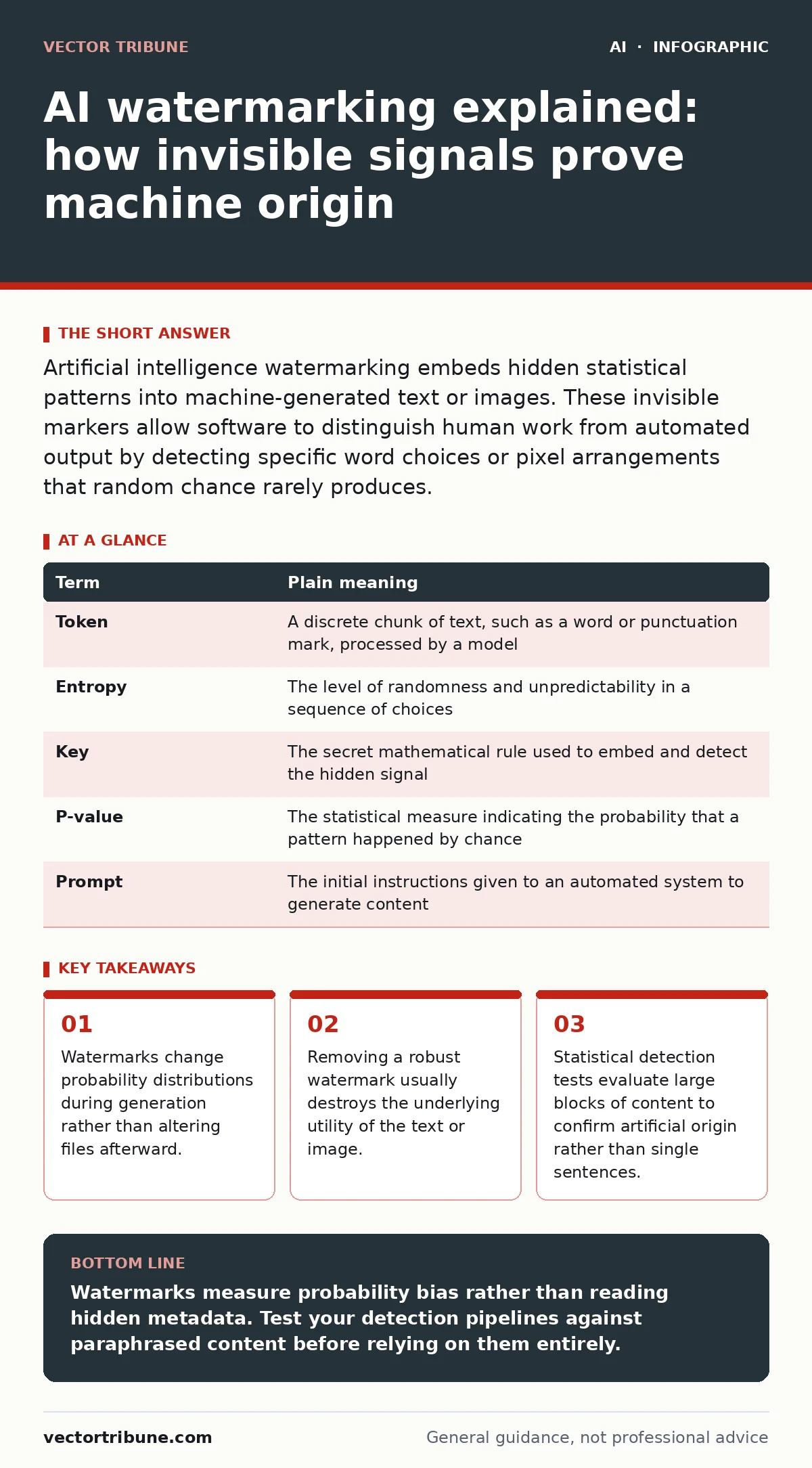
Artificial intelligence watermarking embeds hidden statistical patterns into machine-generated text or images. These invisible markers allow software to distinguish human work from automated output by detecting specific word choices or pixel arrangements that random chance rarely produces.
How invisible ink works in digital art and text
Artificial intelligence watermarking embeds hidden statistical patterns into machine-generated content to prove its origin. Imagine a baker who dusts every third batch of bread with a harmless, tasteless powder that glows only under ultraviolet light. The bread tastes identical to any other loaf, but anyone with the right lamp instantly spots the bakery stamp.
Digital watermarks operate on a similar principle by subtly steering the generation process. Software models choose words or pixels based on mathematical probabilities. A watermarked system restricts these choices to a predetermined subset of possibilities.
The mechanics of token scoring and probability skewing
Token scoring determines which words an automated model selects next during generation. Suppose the baker divides the dictionary into permitted and forbidden halves for certain sentences. The model still writes coherent paragraphs, but it leans heavily toward the permitted vocabulary.
This deliberate skewing creates a measurable bias in the final output. Human writers select words based on personal style and context without following a hidden mathematical rule. Machines configured with a watermark spray specific lexical patterns across the text that accumulate into a detectable signal.
Why deleting the watermark destroys the content
Modifying text or images to erase a hidden marker often ruins the underlying utility of the file. Imagine trying to wash the invisible powder off every single crumb of bread without turning the loaf into mush. Changing enough words to break the statistical pattern usually destroys the grammar, tone, or factual accuracy of the output.
Watermark resilience relies on this trade-off between signal persistence and content quality. If a malicious actor rewrites every sentence to bypass detection, they spend as much effort as writing the text from scratch.
| Term | Plain meaning |
|---|---|
| Token | A discrete chunk of text, such as a word or punctuation mark, processed by a model |
| Entropy | The level of randomness and unpredictability in a sequence of choices |
| Key | The secret mathematical rule used to embed and detect the hidden signal |
| P-value | The statistical measure indicating the probability that a pattern happened by chance |
| Prompt | The initial instructions given to an automated system to generate content |
Common misunderstandings about detection limits
Detecting hidden markers requires sufficient volume to achieve statistical certainty. Short sentences or single paragraphs rarely contain enough data to prove artificial origin reliably. Imagine trying to identify a baker's special flour by tasting a single crumb instead of eating an entire slice.
False positives happen when human writers accidentally match the skewed probability patterns through pure coincidence. Statistical tests account for this background noise by calculating confidence thresholds before flagging content.
When adversarial attacks bypass the invisible stamp
Clever users can degrade watermarks by translating text through multiple languages or paraphrasing sections. Imagine mixing the marked breadcrumbs into a massive pile of plain dough. The ultraviolet glow becomes too faint to read because the signal is diluted beyond recognition.
Securing AI agents and evaluating outputs requires layered defenses beyond a single detection layer. Watermarks fail when adversaries strip the statistical bias faster than detectors can measure it.
See also: Insecure AI plugins and agents: 6 integration mistakes to avoid
Steps to test a statistical detection framework
- Generate a large text sample using a model configured with a specific mathematical bias.
- Run the detection algorithm across the entire output block to count the frequency of favored tokens.
- Compare the resulting score against baseline randomness tables to verify the origin probability.
Key takeaways
- Watermarks change probability distributions during generation rather than altering files afterward.
- Removing a robust watermark usually destroys the underlying utility of the text or image.
- Statistical detection tests evaluate large blocks of content to confirm artificial origin rather than single sentences.
Watermarks measure probability bias rather than reading hidden metadata. Test your detection pipelines against paraphrased content before relying on them entirely.
Frequently asked questions
Can you watermark human-written text?
Human writing lacks the underlying probability bias required for these detection algorithms to function correctly.
Do watermarks slow down generation speeds?
The additional mathematical calculations required to skew token selection add minimal overhead during generation.
Does image watermarking work the same way as text watermarking?
Image watermarks often alter subtle pixel frequencies, whereas text watermarks adjust vocabulary probabilities.
Can watermarks identify which specific user prompted the model?
Advanced systems can embed unique keys per user, though this increases the risk of degrading output quality.
How this guide was produced: written by the Vector Tribune editorial team with AI assistance, checked against the public references listed below, and reviewed when the facts change. See our editorial policy or report an error.