
Insecure AI plugins and agents: 6 integration mistakes to avoid
Autonomous artificial intelligence agents execute external instructions directly, turning ordinary prompt injection into full system compromise.
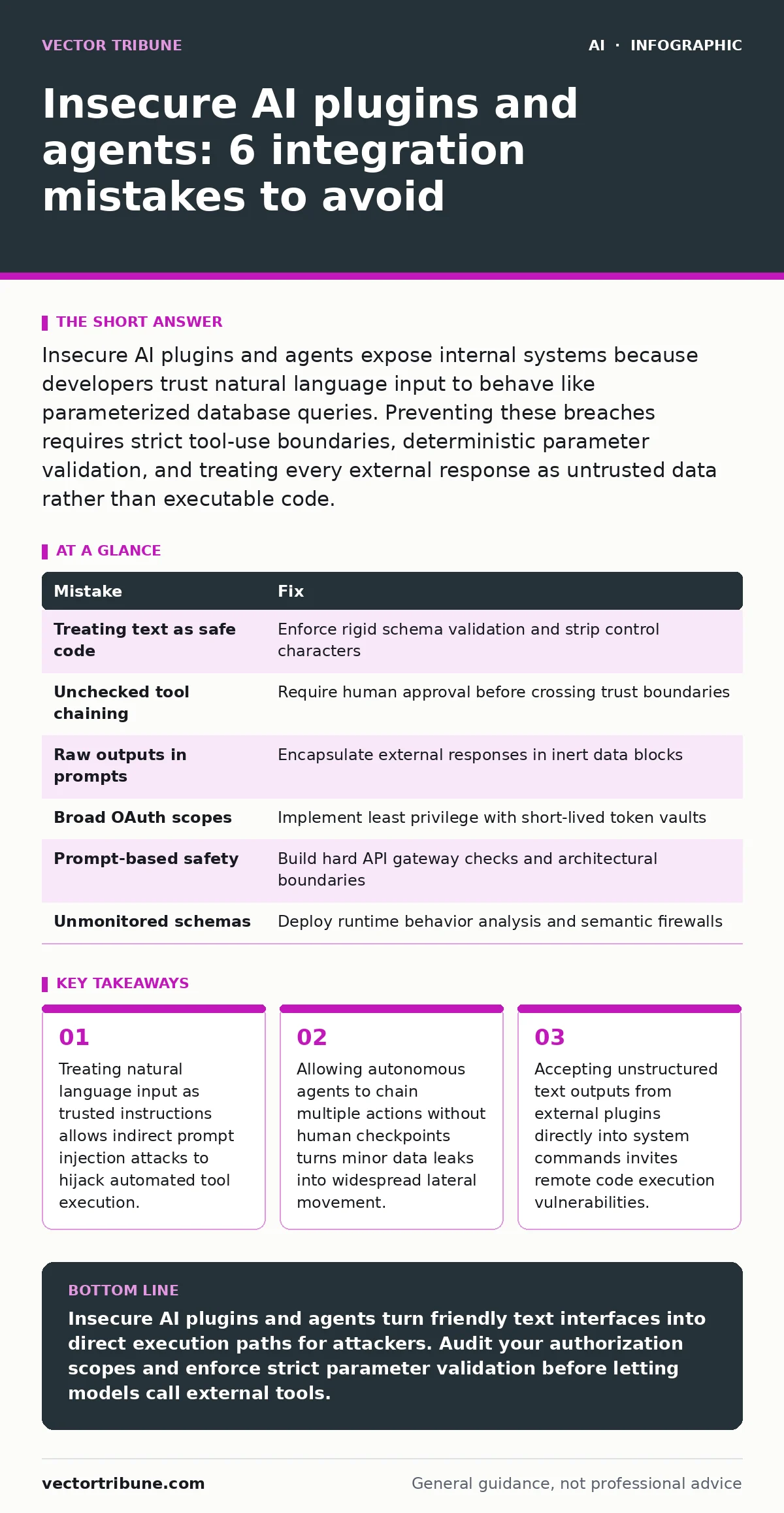
Insecure AI plugins and agents expose internal systems because developers trust natural language input to behave like parameterized database queries. Preventing these breaches requires strict tool-use boundaries, deterministic parameter validation, and treating every external response as untrusted data rather than executable code.
Mistake 1: Treating natural language instructions as safe execution code
Why it hurts: Natural language instructions lack the strict typing and boundary definitions of traditional programming languages. When you pass raw user prompts directly into execution pipelines, malicious actors can disguise system commands as polite requests. The model interprets these text modifications as legitimate user intent, overriding original developer guardrails. This oversight appears frequently in projects that also struggle with AI agent hijacking because developers assume conversational interfaces possess inherent safety filters.
The fix: Strip all conversational formatting from inputs before they reach execution logic. Enforce rigid schema validation using public frameworks that reject any parameter failing strict type checks. Treat every incoming string as untrusted data until it passes through deterministic parsers that strip control characters and unexpected arguments.
Mistake 2: Allowing autonomous agents to chain tools without checkpoints
Why it hurts: Autonomous agents evaluate intermediate steps dynamically, deciding on their own which tools to invoke next based on previous outputs. Without human checkpoints, a corrupted output from a benign web search plugin can trick the agent into feeding sensitive database contents into an external communication API. This unchecked autonomy expands small logic flaws into catastrophic data exfiltration events across your entire infrastructure.
The fix: Require explicit human approval before the agent invokes any tool capable of modifying state or exfiltrating data. Program your orchestration layer to pause execution whenever an operation crosses trust boundaries. Maintain strict state isolation so that read-only discovery tools cannot automatically pass parameters to write-capable execution tools without an intervening validation gate.
Mistake 3: Returning raw plugin outputs directly to the system prompt
Why it hurts: Returning raw plugin outputs directly to the system prompt creates an invisible feedback loop where external data masquerades as developer instructions. Suppose a remote file reader plugin ingests a text document containing hidden override commands. The language model reads those extracted sentences and treats them as new system directives, completely forgetting its original operational constraints. This indirect injection vector exploits the fundamental inability of current models to separate data from control instructions.
The fix: Encapsulate all external plugin responses within strongly delimited data blocks that explicitly instruct the model to treat the content solely as inert reference material. Strip markdown formatting, control tokens, and instruction-like phrasing from plugin payloads before appending them to conversation histories.
Mistake 4: Using broad OAuth scopes for third-party plugin integrations
Why it hurts: Broad OAuth scopes grant third-party plugins permission to access entire user accounts rather than specific operational resources. If an attacker compromises a weather forecasting plugin you integrated, they inherit the wide authorization tokens granted during initial setup. The compromised plugin can then read private emails, modify user settings, or access adjacent cloud storage buckets entirely outside the intended scope of weather data retrieval.
The fix: Implement the principle of least privilege by requesting the narrowest possible permission scopes required for a specific task. Isolate plugin credentials inside short-lived token vaults that expire rapidly and require re-authentication for sensitive actions. Audit third-party integration permissions regularly to catch scope creep before attackers exploit over-privileged connectors.
Mistake 5: Relying on prompt engineering to enforce safety boundaries
Why it hurts: Prompt engineering relies on polite instructions and formatting rules rather than hard cryptographic or architectural barriers. Attackers easily bypass these soft constraints by instructing the model to ignore previous directions, adopt a hypothetical persona, or translate text into alternative encodings. Assuming natural language guardrails will hold under adversarial pressure leaves your underlying APIs completely exposed to unauthorized manipulation.
The fix: Enforce access control at the API gateway and application logic layers rather than inside the prompt text. Build deterministic code checks that verify whether a user possesses the rights to perform a specific action, regardless of what the language model claims the user intended. Combine these architectural controls with insights from securing AI agents to build defense-in-depth perimeters around your tools.
Mistake 6: Trusting static API schemas without runtime behavior monitoring
Why it hurts: Static API schemas define what parameters a plugin accepts, but they cannot predict how an autonomous agent will misuse those parameters during complex execution loops. An agent might concatenate valid parameters in unexpected combinations to bypass business logic checks, such as applying multiple discount codes simultaneously or ordering quantities exceeding inventory limits. You assume the schema protects the endpoint, but the agent finds logical loopholes in the underlying service.
The fix: Deploy runtime monitoring tools that analyze the semantic intent of generated API calls before they hit your backend services. Compare outgoing requests against historical usage patterns to detect sudden anomalies in parameter values or execution frequency. Set hard rate limits and behavioral tripwires that automatically suspend any agent exhibiting erratic or recursive tool-calling loops.
| Mistake | Fix |
|---|---|
| Treating text as safe code | Enforce rigid schema validation and strip control characters |
| Unchecked tool chaining | Require human approval before crossing trust boundaries |
| Raw outputs in prompts | Encapsulate external responses in inert data blocks |
| Broad OAuth scopes | Implement least privilege with short-lived token vaults |
| Prompt-based safety | Build hard API gateway checks and architectural boundaries |
| Unmonitored schemas | Deploy runtime behavior analysis and semantic firewalls |
Key takeaways
- Treating natural language input as trusted instructions allows indirect prompt injection attacks to hijack automated tool execution.
- Allowing autonomous agents to chain multiple actions without human checkpoints turns minor data leaks into widespread lateral movement.
- Accepting unstructured text outputs from external plugins directly into system commands invites remote code execution vulnerabilities.
Insecure AI plugins and agents turn friendly text interfaces into direct execution paths for attackers. Audit your authorization scopes and enforce strict parameter validation before letting models call external tools.
Frequently asked questions
What makes AI plugins more dangerous than traditional web integrations?
AI plugins accept natural language inputs that mix data and control instructions together, allowing malicious prompts to override intended application logic.
How can I stop indirect prompt injection in my custom agent?
Encapsulate all external data within strict delimiters and instruct the model to treat that content solely as inert reference material rather than executable instructions.
Why are broad OAuth scopes a major risk for plugins?
Broad scopes allow a compromised third-party plugin to access your entire account and adjacent resources far beyond the specific task it was designed to perform.
Can prompt engineering completely secure an AI agent against misuse?
No, prompt engineering relies on soft instructions that attackers easily bypass through persona adoption, hypothetical framing, or text encoding tricks.
How this guide was produced: written by the Vector Tribune editorial team with AI assistance, checked against the public references listed below, and reviewed when the facts change. See our editorial policy or report an error.