AI Watermarking: How Invisible Signals Track Synthetic Content
AI watermarking embeds subtle statistical patterns into output, allowing systems to distinguish machine-generated content from human-created work without altering visible quality.
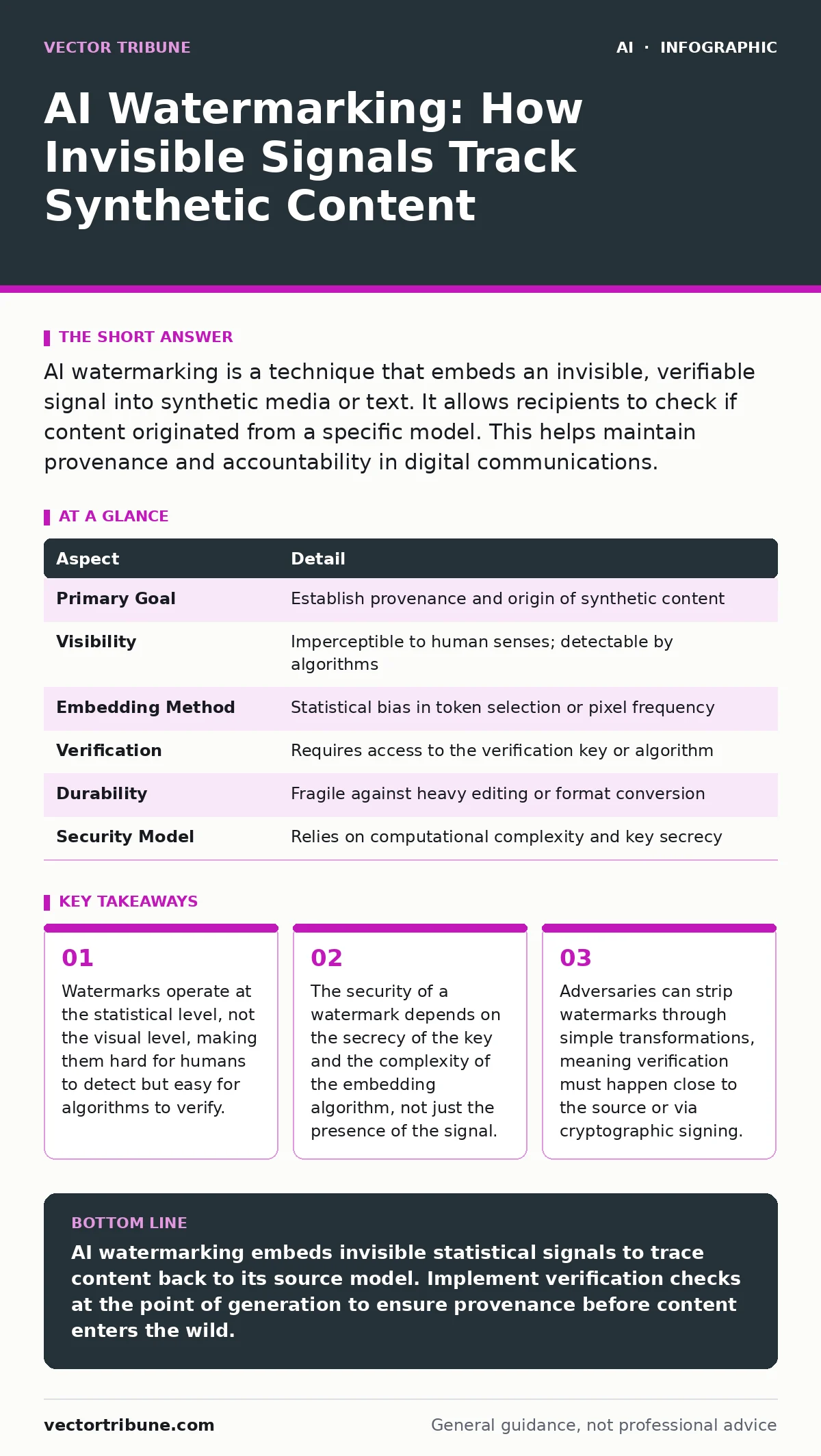
AI watermarking is a technique that embeds an invisible, verifiable signal into synthetic media or text. It allows recipients to check if content originated from a specific model. This helps maintain provenance and accountability in digital communications.
The Invisible Ink of Digital Creation
Imagine sending a letter with a watermark that only appears under ultraviolet light. The recipient reads the text normally, but a specific filter reveals the sender’s identity. AI watermarking works similarly, but the "ultraviolet light" is a mathematical check rather than a physical filter.
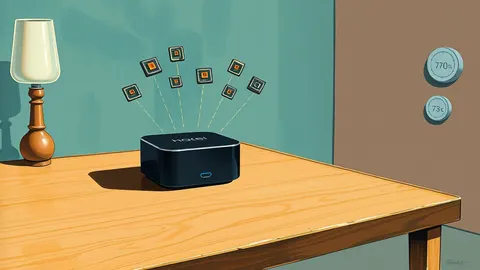
You cannot see the watermark with your eyes. It exists as slight, intentional biases in the data structure of the image, audio, or text. For text, this might mean the model slightly prefers certain synonyms over others in a pattern that looks random to a reader but matches a specific key to a verifier. For images, it might be subtle noise added to frequency domains that human vision ignores but computers can isolate.
This mechanism provides provenance. It answers the question of origin without interfering with the utility of the content. The goal is to let the content function normally while carrying a hidden receipt of its creation.
| Aspect | Detail |
|---|---|
| Primary Goal | Establish provenance and origin of synthetic content |
| Visibility | Imperceptible to human senses; detectable by algorithms |
| Embedding Method | Statistical bias in token selection or pixel frequency |
| Verification | Requires access to the verification key or algorithm |
| Durability | Fragile against heavy editing or format conversion |
| Security Model | Relies on computational complexity and key secrecy |
How Embedding Works in Practice
The process begins during generation. When a large language model decides which word comes next, it does not pick the single most probable word. It picks from a distribution. Watermarking tilts this distribution.
Suppose the model is about to choose between "happy" and "joyful." A standard model picks based on semantic fit. A watermarked model adds a small bias based on a secret key. If the key suggests "happy," the probability of "happy" increases slightly. This happens thousands of times per paragraph. To you, the text reads naturally. To a verifier running the same key, the pattern of choices is statistically impossible to occur by chance.
For images, the process often occurs in the latent space. This is the compressed representation of the image before it is decoded into pixels. The model adds a structured noise pattern to this latent representation. When the image is rendered, the noise becomes part of the texture. It is smooth enough to be invisible but distinct enough to be extracted later.
The Fragility of Imperceptibility
Watermarking faces a fundamental trade-off: imperceptibility versus robustness. If the signal is strong, it is easy to detect but might distort the content. If the signal is weak, the content looks perfect, but the signal breaks easily.
Most current watermarks are fragile. They assume the content remains largely unchanged after generation. If you crop an image, compress a video, or rewrite a paragraph, the watermark can be destroyed. This is not a bug; it is a consequence of hiding information in the data itself.
This fragility creates a gap between generation and verification. If the content passes through multiple hands, the watermark may vanish long before it reaches the end user. This limits the effectiveness of watermarks for long-term attribution on the open web. It works best in closed loops where the content is verified immediately after creation.
What People Usually Get Wrong
Many assume that watermarks are cryptographic signatures. They are not. A cryptographic signature guarantees integrity and authenticity using public-key infrastructure. A watermark is a statistical anomaly. It can be forged if the adversary knows the key. It can be removed if the adversary applies enough noise.
Another common error is believing watermarks prevent misuse. They do not. A watermark tells you where content came from; it does not stop someone from using that content for deception. It is a labeling mechanism, not a containment mechanism.
Confusing watermarks with deepfake detection tools leads to false confidence. Detection tools analyze content for artifacts of synthesis. Watermarks embed a specific signal. A detector might flag an image as AI-generated, but only a watermark can say which model generated it. One identifies the class; the other identifies the source.
The Risk of Key Exposure
The security of the watermark rests on the secrecy of the embedding key. If an attacker discovers the key, they can generate content that bypasses detection or create false positives. This is similar to encrypting data with a weak password.
In open-source models, the watermarking algorithm is often public. This means the security relies entirely on the private key. If that key is leaked, the entire provenance system for that model collapses. Attackers can then generate content that looks natural but carries no watermark, or worse, carries a fake watermark from a trusted source.
This is why AI supply chain risks are critical. If you use a third-party model that claims to have watermarking, you must trust that the provider has secured the keys. You cannot verify the watermarking strength without auditing the implementation, which is often impossible with proprietary black-box models.
Integration with Governance Frameworks
Watermarking is a technical control that supports broader policy goals. It fits into AI governance by providing an audit trail. Organizations can require that all public-facing AI output carries a verifiable signal. This creates a standard for accountability.
However, technical controls must align with legal and ethical standards. Watermarking raises privacy concerns if it tracks individual user prompts. It also raises interoperability issues. If every model uses a different watermarking scheme, verification becomes a nightmare. Standardization is slow, leading to a fragmented ecosystem where no single tool can verify all content.
For developers, this means building verification into the application layer. Do not rely on the end user to check for watermarks. Build the check into the workflow. If your application uses retrieval-augmented generation security practices, treat the watermark as part of the data integrity check. Verify before you display.
The Future of Provenance
As models become more sophisticated, the distinction between human and machine output will blur. Watermarking provides a necessary anchor in this shifting landscape. It does not solve the problem of misinformation, but it provides a tool for verification.
The next step is moving from fragile statistical watermarks to cryptographically bound signatures. This would require changes in how models are deployed and how content is distributed. Until then, watermarks remain a best-effort signal, not a guarantee.
Key takeaways
- Watermarks operate at the statistical level, not the visual level, making them hard for humans to detect but easy for algorithms to verify.
- The security of a watermark depends on the secrecy of the key and the complexity of the embedding algorithm, not just the presence of the signal.
- Adversaries can strip watermarks through simple transformations, meaning verification must happen close to the source or via cryptographic signing.
AI watermarking embeds invisible statistical signals to trace content back to its source model. Implement verification checks at the point of generation to ensure provenance before content enters the wild.
Frequently asked questions
Can I remove an AI watermark from an image or text?
Yes, most current watermarks are fragile. Cropping, compressing, or paraphrasing content can remove the statistical signal, making verification impossible.
Is AI watermarking legally required?
Requirements vary by jurisdiction and industry. Some regions mandate disclosure of AI-generated content, but specific technical standards for watermarking are still emerging.
How does watermarking differ from digital signatures?
Digital signatures use cryptography to guarantee integrity and identity. Watermarks use statistical patterns that can be altered or removed without breaking the content itself.
Do all AI models have watermarks?
No. Only models explicitly designed with watermarking algorithms include these signals. Many open-source and proprietary models do not embed any provenance signals by default.
How this guide was produced: written by the Vector Tribune editorial team with AI assistance, checked against the public references listed below, and reviewed when the facts change. See our editorial policy or report an error.