
Fine-Tuning vs Prompt Engineering: Which AI Method Fits Your Stack
Prompt engineering shapes output without altering the model, while fine-tuning permanently changes weights for specific tasks at a higher computational cost.
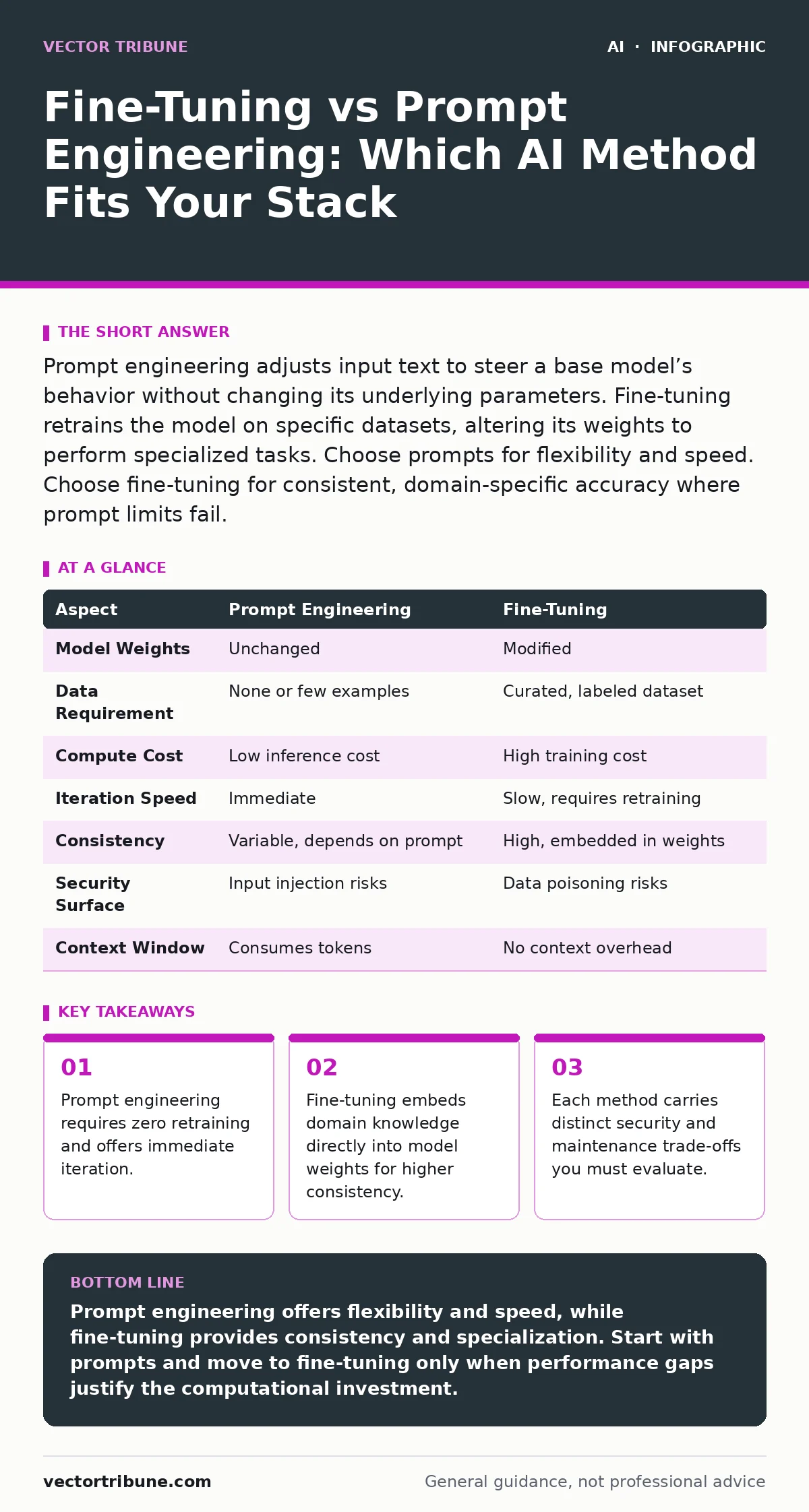
Prompt engineering adjusts input text to steer a base model’s behavior without changing its underlying parameters. Fine-tuning retrains the model on specific datasets, altering its weights to perform specialized tasks. Choose prompts for flexibility and speed. Choose fine-tuning for consistent, domain-specific accuracy where prompt limits fail.
The Core Difference Between Fine-Tuning and Prompt Engineering
Fine-tuning and prompt engineering represent two distinct approaches to adapting large language models for specific tasks. Prompt engineering relies on crafting precise input instructions to guide the model’s existing knowledge. Fine-tuning involves additional training on a curated dataset to modify the model’s internal weights. The former changes how you ask questions; the latter changes what the model knows. Understanding this distinction prevents wasted compute resources and misaligned expectations. You select one based on whether you need temporary flexibility or permanent specialization. This choice impacts latency, cost, and security posture significantly.
What Is Prompt Engineering?
Prompt engineering is the practice of designing input text to elicit desired outputs from a pre-trained model. You manipulate context, examples, and constraints within the input window. The model’s parameters remain unchanged. This method leverages the model’s existing general knowledge. It allows rapid iteration without retraining infrastructure. Developers often chain multiple prompts to achieve complex reasoning steps. This approach scales horizontally by adjusting text rather than computing power. It remains effective for tasks where the base model already possesses the necessary foundational knowledge. You control the output distribution through textual cues alone.
What Is Fine-Tuning?
Fine-tuning extends the pre-training process by exposing the model to a specialized dataset. The model updates its weight matrices to minimize error on this new data. This embeds domain-specific patterns directly into the model’s architecture. The result is a model that behaves differently from its base version. It requires significant computational resources and data preparation. Fine-tuning is necessary when the base model lacks specific vocabulary or reasoning patterns. It creates a persistent change in behavior. Unlike prompting, the model does not need context examples in every request. This reduces input token costs and latency for repeated tasks.
Comparison: Fine-Tuning vs Prompt Engineering
| Aspect | Prompt Engineering | Fine-Tuning |
|---|---|---|
| Model Weights | Unchanged | Modified |
| Data Requirement | None or few examples | Curated, labeled dataset |
| Compute Cost | Low inference cost | High training cost |
| Iteration Speed | Immediate | Slow, requires retraining |
| Consistency | Variable, depends on prompt | High, embedded in weights |
| Security Surface | Input injection risks | Data poisoning risks |
| Context Window | Consumes tokens | No context overhead |
When To Choose Prompt Engineering
Choose prompt engineering when the task relies on general knowledge the base model already possesses. This method suits exploratory workflows where requirements change frequently. You gain the ability to test multiple strategies without infrastructure overhead. It works well for summarization, translation, or basic classification. The input context remains transparent and auditable. You can easily adjust tone or format by modifying text. This approach avoids the complexity of data labeling. It remains the default starting point for most new applications. You retain full control over the immediate context.
When To Choose Fine-Tuning
Choose fine-tuning when the task requires specialized terminology or reasoning patterns absent from general pre-training. This method suits high-volume production environments where consistency matters. You reduce the need for extensive context examples in every request. It works well for legal document analysis, medical coding, or proprietary syntax. The model learns to prioritize specific data distributions. This reduces hallucination rates for niche topics. You accept higher upfront costs for long-term efficiency. It creates a dedicated model instance for a specific function.
Overlap and Hybrid Strategies
Both methods often work together in production systems. You might fine-tune a model for domain accuracy and then use prompts for formatting. This hybrid approach maximizes the strengths of each technique. Fine-tuning handles the heavy lifting of knowledge retention. Prompt engineering handles the dynamic aspects of user interaction. You must manage the security implications of both layers. Input validation remains critical even for fine-tuned models. Data quality determines the success of fine-tuning. Prompt clarity determines the success of inference. Balancing these factors requires careful architectural planning.
Security Implications for Your Stack
Prompt engineering exposes your system to prompt injection attacks. Malicious inputs can override system instructions and leak sensitive data. You must sanitize and validate all user inputs. Fine-tuning introduces data poisoning risks during the training phase. Adversarial examples in training data can create hidden backdoors. You must verify the integrity and source of training datasets. Both methods require monitoring for unexpected behavior changes. Understanding AI supply chain risks helps you evaluate the trustworthiness of base models and data sources. Secure your inference endpoints against abuse.
Implementation Considerations
You must evaluate the total cost of ownership for each approach. Prompt engineering scales with token usage and latency. Fine-tuning scales with compute resources and data maintenance. Choose the method that aligns with your operational constraints. Test both approaches with a small subset of data. Measure accuracy, latency, and cost rigorously. Document the rationale for your choice. This decision impacts your long-term AI strategy. Consider how retrieval-augmented generation security might complement your chosen method for factual accuracy. Plan for continuous evaluation and monitoring.
Key takeaways
- Prompt engineering requires zero retraining and offers immediate iteration.
- Fine-tuning embeds domain knowledge directly into model weights for higher consistency.
- Each method carries distinct security and maintenance trade-offs you must evaluate.
Prompt engineering offers flexibility and speed, while fine-tuning provides consistency and specialization. Start with prompts and move to fine-tuning only when performance gaps justify the computational investment.
Frequently asked questions
Can I fine-tune a model without any training data?
No, fine-tuning requires a curated dataset of inputs and expected outputs to adjust the model's weights effectively.
Does prompt engineering change the model's underlying intelligence?
No, prompt engineering only influences the model's immediate response without altering its permanent parameters or knowledge base.
Which method is more secure against data leakage?
Prompt engineering carries higher risks of injection and context leakage, while fine-tuning risks data poisoning during the training phase.
How do I know if my task requires fine-tuning?
Consider fine-tuning if the base model consistently fails to understand domain-specific terminology or reasoning patterns despite optimized prompts.
How this guide was produced: written by the Vector Tribune editorial team with AI assistance, checked against the public references listed below, and reviewed when the facts change. See our editorial policy or report an error.